Skip to main content
Genetics
My Course
Learn
Exam Prep
AI Tutor
Study Guides
Textbook Solutions
Flashcards
Explore
Try the app
My Course
Learn
Exam Prep
AI Tutor
Study Guides
Textbook Solutions
Flashcards
Explore
Try the app
Back
Mitosis definitions
You can tap to flip the card.
Mitosis
You can tap to flip the card.
👆
Mitosis
A process producing two genetically identical cells, essential for growth and tissue repair in multicellular organisms.
Track progress
Control buttons has been changed to "navigation" mode.
1/15
Related flashcards
Related practice
Recommended videos
Mitosis quiz #1
Mitosis
40 Terms
Mitosis quiz #2
Mitosis
32 Terms
Mitosis
9. Mitosis and Meiosis
7 problems
Topic
Kylia
Meiosis
9. Mitosis and Meiosis
7 problems
Topic
Kylia
9. Mitosis and Meiosis
4 topics
10 problems
Chapter
Kylia
Guided course
05:02
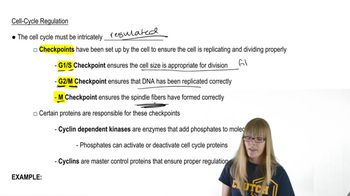
Mitosis Regulation
2020
views
31
rank
Guided course
09:46
Mitosis Steps
3669
views
46
rank
5
comments
Terms in this set (15)
Hide definitions
Mitosis
A process producing two genetically identical cells, essential for growth and tissue repair in multicellular organisms.
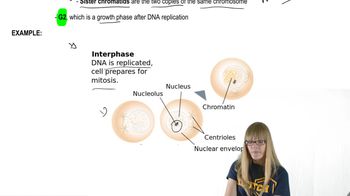
Interphase
A preparatory stage with cell growth and DNA replication, occurring before visible cell division begins.
Prophase
A stage where chromatin condenses, centrosomes move apart, and the nuclear envelope starts to break down.
Metaphase
A phase where chromosomes align at the cell's equator, attached to spindle fibers via kinetochores.
Anaphase
A stage marked by the separation of sister chromatids, which are pulled toward opposite cell poles.
Telophase
A phase where separated chromosomes reach cell poles and nuclear envelopes begin to reform around them.
Cytokinesis
A process dividing the cytoplasm, resulting in two distinct daughter cells after mitosis.
Chromatin
A complex of DNA and proteins that condenses to form visible chromosomes during cell division.
Chromosome
A condensed structure of DNA and protein, visible during cell division, carrying genetic information.
Sister Chromatid
One of two identical DNA copies formed during replication, joined together before being separated in mitosis.
Centrosome
A cellular structure organizing microtubules and spindle fibers, crucial for chromosome movement.
Spindle Fiber
A microtubule structure extending from centrosomes, responsible for moving chromosomes during division.
Kinetochore
A protein complex at the chromosome centromere, serving as the attachment site for spindle fibers.
Cell Cycle Checkpoint
A regulatory control point ensuring proper cell size, DNA replication, and spindle attachment before division proceeds.
Cyclin-dependent Kinase
An enzyme regulated by cyclins, adding phosphates to proteins to control cell cycle progression.
 BackBack
 05:02
05:02