What is the function of RNA polymerase in protein synthesis?
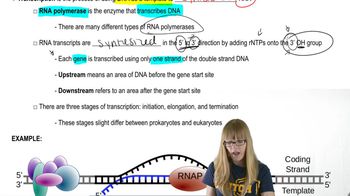
RNA polymerase synthesizes mRNA from DNA, which is then used in protein synthesis.
What is the role of RNA polymerase in protein synthesis?
RNA polymerase transcribes DNA into mRNA, providing the template for protein synthesis.
How many strands of DNA are copied in transcription?
Only one strand of DNA, the template strand, is copied during transcription.
RNA polymerase makes a copy of what?
RNA polymerase makes a copy of the DNA template strand in the form of RNA.
In which direction is the RNA transcript synthesized during transcription?
The RNA transcript is synthesized in the 5' to 3' direction. New nucleotides are added to the 3' end of the growing RNA strand.
What is the significance of the hydroxyl group at the 3' end of the growing RNA strand?
The hydroxyl group at the 3' end allows new nucleotides to be added during RNA synthesis. This is essential for elongating the RNA molecule.
What do the terms 'upstream' and 'downstream' refer to in the context of transcription?
'Upstream' refers to DNA sequences before the gene start site, while 'downstream' refers to sequences after the gene start site. These terms help describe locations relative to the gene being transcribed.
How does the RNA sequence compare to the coding strand of DNA?
The RNA sequence is identical to the coding strand except that uracil replaces thymine. This means every thymine in DNA is replaced by uracil in RNA.
What are the three main stages of transcription?
The three main stages of transcription are initiation, elongation, and termination. These stages can differ slightly between prokaryotes and eukaryotes.
Why is understanding the orientation of DNA strands important in transcription?
Understanding strand orientation is crucial because only one strand (the template strand) is used to synthesize RNA. The directionality determines which strand serves as the template and how the RNA is built.
 Back
Back
 06:32
06:32