Skip to main content
Genetics
My Course
Learn
Exam Prep
AI Tutor
Study Guides
Textbook Solutions
Flashcards
Explore
Try the app
My Course
Learn
Exam Prep
AI Tutor
Study Guides
Textbook Solutions
Flashcards
Explore
Try the app
Back
RNA definitions
You can tap to flip the card.
Ribose
You can tap to flip the card.
👆
Ribose
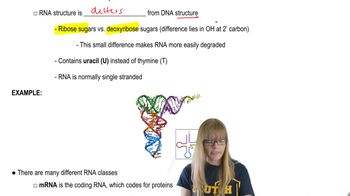
A five-carbon sugar with a hydroxyl group at the 2' carbon, increasing reactivity and susceptibility to degradation.
Track progress
Control buttons has been changed to "navigation" mode.
1/14
Related flashcards
Related practice
Recommended videos
RNA quiz #1
RNA
40 Terms
RNA quiz #2
RNA
40 Terms
RNA quiz #3
RNA
40 Terms
RNA
7. DNA and Chromosome Structure
3 problems
Topic
Kylia
Bacterial and Viral Chromosome Structure
7. DNA and Chromosome Structure
5 problems
Topic
Kylia
7. DNA and Chromosome Structure
6 topics
14 problems
Chapter
Kylia
Guided course
05:43
RNA
2032
views
36
rank
1
comments
Terms in this set (14)
Hide definitions
Ribose
A five-carbon sugar with a hydroxyl group at the 2' carbon, increasing reactivity and susceptibility to degradation.
Ribozyme
A folded RNA structure capable of catalyzing chemical reactions, acting similarly to protein enzymes.
Uracil
A nitrogenous base unique to RNA, replacing thymine and pairing with adenine during transcription.
Single-stranded Structure
A typical conformation of RNA, allowing complex folding and diverse functional roles within the cell.
mRNA
A coding molecule that carries genetic instructions from DNA to ribosomes for protein synthesis.
tRNA
A molecule that delivers specific amino acids to the ribosome, facilitating polypeptide chain assembly.
rRNA
A structural and catalytic component of ribosomes, essential for translating mRNA into proteins.
Non-coding RNA
A class of RNA molecules not translated into proteins but involved in regulation and other cellular processes.
MicroRNA
A small regulatory RNA that modulates gene expression by silencing or degrading target mRNAs.
siRNA
A short RNA involved in gene silencing, playing a key role in RNA interference pathways.
snRNA
A small nuclear RNA crucial for processing pre-mRNA into mature mRNA within the nucleus.
snoRNA
A small nucleolar RNA responsible for processing and modifying ribosomal RNA molecules.
Hydroxyl Group
A functional group attached to ribose at the 2' carbon, increasing RNA's chemical reactivity.
Genetic Material
A molecule capable of storing and transmitting hereditary information, with RNA considered the earliest form.
 BackBack
 05:43
05:43