Skip to main content
Genetics
My Course
Learn
Exam Prep
AI Tutor
Study Guides
Textbook Solutions
Flashcards
Explore
Try the app
My Course
Learn
Exam Prep
AI Tutor
Study Guides
Textbook Solutions
Flashcards
Explore
Try the app
Back
Semiconservative Replication definitions
You can tap to flip the card.
DNA Replication
You can tap to flip the card.
👆
DNA Replication
Cellular process producing identical DNA molecules, ensuring genetic information is passed to daughter cells during division.
Track progress
Control buttons has been changed to "navigation" mode.
1/15
Related flashcards
Related practice
Recommended videos
Semiconservative Replication quiz #1
Semiconservative Replication
40 Terms
Semiconservative Replication quiz #2
Semiconservative Replication
16 Terms
Semiconservative Replication
8. DNA Replication
4 problems
Topic
Kylia
Overview of DNA Replication
8. DNA Replication
7 problems
Topic
Kylia
8. DNA Replication
4 topics
9 problems
Chapter
Kylia
Guided course
14:31
Semiconservative Replication
2668
views
51
rank
1
comments
Terms in this set (15)
Hide definitions
DNA Replication
Cellular process producing identical DNA molecules, ensuring genetic information is passed to daughter cells during division.
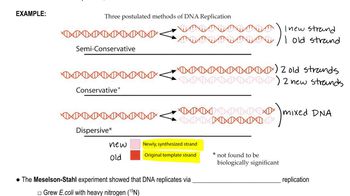
Semi-Conservative Replication
Each new DNA double helix contains one parental strand and one newly synthesized strand after replication.
Conservative Replication
Model proposing that the original DNA helix remains intact while an entirely new double helix is formed.
Dispersive Replication
Model suggesting that both DNA helices contain interspersed segments of old and new DNA after replication.
Meselson-Stahl Experiment
Classic study using nitrogen isotopes in E. coli to distinguish between DNA replication models by analyzing DNA density.
E. coli
Bacterial species used as a model organism due to its rapid division and suitability for DNA replication studies.
Nitrogen-15
Heavy isotope incorporated into DNA to label original strands, allowing differentiation from newly synthesized DNA.
Nitrogen-14
Light isotope used to label new DNA strands, enabling visualization of replication patterns in experiments.
Density Gradient
Technique separating DNA molecules based on mass, revealing differences in isotope incorporation after replication.
Double Helix
Structural form of DNA consisting of two intertwined strands, serving as the template during replication.
Template Strand
Original DNA strand used as a guide for synthesizing a complementary new strand during replication.
Band
Visible region in a density gradient tube indicating DNA of a specific mass or isotope composition.
Petri Dish
Shallow laboratory container used to culture bacteria, providing controlled environments for experimental manipulation.
Replication Cycle
Complete sequence of events in which DNA is duplicated, resulting in two DNA molecules from one original.
Strand
Linear sequence of nucleotides forming one half of the DNA double helix, either parental or newly synthesized.
 BackBack
 14:31
14:31