Skip to main content
Genetics
My Course
Learn
Exam Prep
AI Tutor
Study Guides
Textbook Solutions
Flashcards
Explore
Try the app
My Course
Learn
Exam Prep
AI Tutor
Study Guides
Textbook Solutions
Flashcards
Explore
Try the app
Back
The Genetic Code definitions
You can tap to flip the card.
Codon
You can tap to flip the card.
👆
Codon
A sequence of three nucleotides in mRNA that specifies a particular amino acid or signals translation termination.
Track progress
Control buttons has been changed to "navigation" mode.
1/15
Related flashcards
Related practice
Recommended videos
The Genetic Code quiz #1
The Genetic Code
40 Terms
The Genetic Code quiz #2
The Genetic Code
10 Terms
The Genetic Code
11. Translation
7 problems
Topic
Kylia
Transfer RNA
11. Translation
7 problems
Topic
Kylia
11. Translation
5 topics
13 problems
Chapter
Kylia
Guided course
11:43
The Genetic Code
2660
views
26
rank
6
comments
Terms in this set (15)
Hide definitions
Codon
A sequence of three nucleotides in mRNA that specifies a particular amino acid or signals translation termination.
Triplet Code
A system where three consecutive nucleotides determine the identity of a single amino acid during protein synthesis.
Degeneracy
A feature where multiple nucleotide triplets can encode the same amino acid, providing redundancy in the code.
Non-overlapping
A property where each nucleotide is read only once as part of a single codon, preventing shared bases between codons.
Universality
A characteristic where nearly all organisms use the same nucleotide-to-amino acid correspondence, with rare exceptions.
Start Codon
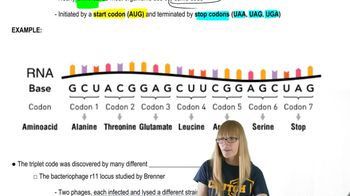
A specific nucleotide triplet (AUG) that signals the initiation of translation and the first amino acid in a protein.
Stop Codon
One of three nucleotide triplets (UAA, UAG, UGA) that signal the end of translation, not coding for any amino acid.
Reading Frame
A way of dividing a nucleotide sequence into consecutive, non-overlapping triplets for translation.
Bacteriophage
A virus that infects bacterial cells, often used in experiments to study genetic mechanisms.
Mutation
A change in the nucleotide sequence that can alter the reading frame or amino acid sequence of a protein.
Reversion
A genetic event where a second mutation restores the original phenotype, often by correcting a previous reading frame disruption.
RNA Homopolymer
A synthetic RNA molecule composed of only one type of nucleotide, used to decipher codon assignments.
RNA Heteropolymer
A synthetic RNA molecule containing two or more types of nucleotides in a repeating pattern, aiding in code deciphering.
Polypeptide
A chain of amino acids assembled according to the sequence of codons in mRNA during translation.
Proflavin
A chemical mutagen that induces single nucleotide insertions or deletions, used to study reading frame shifts.
 BackBack
 11:43
11:43