
Several temperature-sensitive mutant strains of E. coli display the following characteristics. Predict what enzyme or function is being affected by each mutation.
Synthesis is very slow.
Verified step by step guidance
Several temperature-sensitive mutant strains of E. coli display the following characteristics. Predict what enzyme or function is being affected by each mutation.
Synthesis is very slow.
Several temperature-sensitive mutant strains of E. coli display the following characteristics. Predict what enzyme or function is being affected by each mutation.
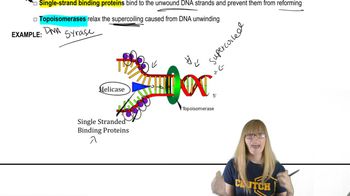
Supercoiled strands remain after replication, which is never completed.
Many of the gene products involved in DNA synthesis were initially defined by studying mutant E. coli strains that could not synthesize DNA.
The dnaE gene encodes the α subunit of DNA polymerase III. What effect is expected from a mutation in this gene? How could the mutant strain be maintained?
Assume a hypothetical organism in which DNA replication is conservative. Design an experiment similar to that of Taylor, Woods, and Hughes that will unequivocally establish this fact. Using the format established in Figure 11.5, draw sister chromatids and illustrate the expected results establishing this mode of replication.
In 1994, telomerase activity was discovered in human cancer cell lines. Although telomerase is not active in most human adult cells, all cells do contain the genes for telomerase proteins and telomerase RNA. Since inappropriate activation of telomerase may contribute to cancer, why do you think the genes coding for this enzyme have been maintained in the human genome throughout evolution? Are there any types of human body cells where telomerase activation would be advantageous or even necessary? Explain.