
Textbook Question
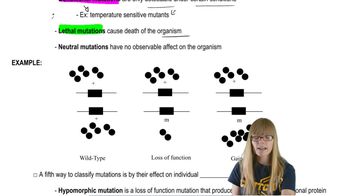
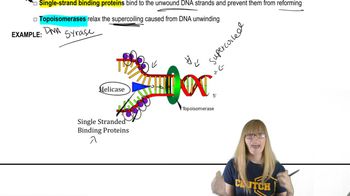
Several temperature-sensitive mutant strains of E. coli display the following characteristics. Predict what enzyme or function is being affected by each mutation.
Newly synthesized DNA contains many mismatched base pairs.
669
views

 Verified step by step guidance
 10:48
10:48
 11:59 11:59
Several temperature-sensitive mutant strains of E. coli display the following characteristics. Predict what enzyme or function is being affected by each mutation.
Newly synthesized DNA contains many mismatched base pairs.
Several temperature-sensitive mutant strains of E. coli display the following characteristics. Predict what enzyme or function is being affected by each mutation.
Okazaki fragments accumulate, and DNA synthesis is never completed.
Several temperature-sensitive mutant strains of E. coli display the following characteristics. Predict what enzyme or function is being affected by each mutation.
Synthesis is very slow.
Several temperature-sensitive mutant strains of E. coli display the following characteristics. Predict what enzyme or function is being affected by each mutation.
Supercoiled strands remain after replication, which is never completed.
Many of the gene products involved in DNA synthesis were initially defined by studying mutant E. coli strains that could not synthesize DNA.
The dnaE gene encodes the α subunit of DNA polymerase III. What effect is expected from a mutation in this gene? How could the mutant strain be maintained?
Why is DNA synthesis expected to be more complex in eukaryotes than in bacteria? How is DNA synthesis similar in the two types of organisms?