Pearson+ LogoPearson+ Logo
Ch. 11 - Chromosome Structure and DNA Sequence Organization
Klug - Essentials of Genetics 10th Edition
Klug10th EditionEssentials of GeneticsISBN: 9780135588789Not the one you use?Change textbook
Chapter 11, Problem 12

Contrast the various categories of repetitive DNA.

Verified step by step guidance
1
Begin by defining repetitive DNA as sequences that occur multiple times in the genome, often playing roles in genome structure and function.
Classify repetitive DNA into two main categories: tandem repeats and interspersed repeats.
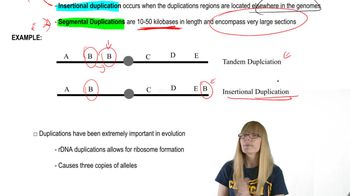
Explain tandem repeats, which are sequences repeated one after another in a head-to-tail fashion; these include satellite DNA, minisatellites, and microsatellites, differing mainly in the length of the repeat unit.
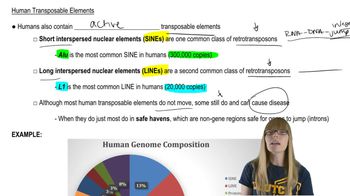
Describe interspersed repeats, which are scattered throughout the genome and primarily consist of transposable elements such as LINEs (Long Interspersed Nuclear Elements) and SINEs (Short Interspersed Nuclear Elements).
Contrast the categories by their organization (tandem vs. dispersed), repeat unit size, and biological roles, highlighting how tandem repeats often contribute to structural features like centromeres, while interspersed repeats can influence genome evolution and gene regulation.

Verified video answer for a similar problem:

This video solution was recommended by our tutors as helpful for the problem above.
Video duration:
1m
Was this helpful?

Key Concepts

Here are the essential concepts you must grasp in order to answer the question correctly.

Types of Repetitive DNA

Repetitive DNA consists of sequences repeated multiple times in the genome. It is broadly categorized into tandem repeats, where sequences are adjacent, and interspersed repeats, which are scattered throughout the genome.
Recommended video:
Guided course
01:45
DNA Proofreading

Tandem Repeats

Tandem repeats include satellite DNA, minisatellites, and microsatellites, differing in repeat unit length. These repeats are often found in centromeres and telomeres and play roles in chromosome structure and genetic variation.
Recommended video:

Interspersed Repeats

Interspersed repeats are mainly transposable elements like LINEs and SINEs that can move within the genome. They contribute to genome size variation and can influence gene regulation and genome evolution.
Recommended video:
Guided course
05:30
Human Transposable Elements