Pearson+ LogoPearson+ Logo
Ch. 13 - Translation and Proteins
Klug - Essentials of Genetics 10th Edition
Klug10th EditionEssentials of GeneticsISBN: 9780135588789Not the one you use?Change textbook
Chapter 13, Problem 16

In your opinion, which of the four levels of protein organization is the most critical to a protein’s function? Defend your choice.

Verified step by step guidance
1
Step 1: Understand the four levels of protein structure: primary, secondary, tertiary, and quaternary. Each level describes a different aspect of the protein's shape and complexity.
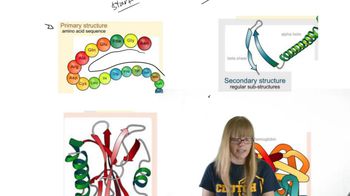
Step 2: Define each level briefly: Primary structure is the linear sequence of amino acids; secondary structure involves local folding patterns like alpha-helices and beta-sheets; tertiary structure is the overall 3D shape of a single polypeptide chain; quaternary structure is the arrangement of multiple polypeptide subunits.
Step 3: Consider how each level contributes to protein function. The primary structure determines the amino acid sequence, which influences folding; secondary structures stabilize local regions; tertiary structure creates the active site and overall shape necessary for function; quaternary structure allows interaction between subunits for complex functions.
Step 4: Argue why one level might be the most critical. For example, the tertiary structure is often considered most critical because it determines the protein's specific 3D shape, which is essential for binding substrates and performing biological functions.
Step 5: Support your choice with examples or reasoning, such as how misfolding at the tertiary level can lead to loss of function or diseases, emphasizing the importance of correct 3D conformation for protein activity.

Key Concepts

Here are the essential concepts you must grasp in order to answer the question correctly.

Primary Structure of Proteins

The primary structure is the linear sequence of amino acids in a protein, held together by peptide bonds. It determines the protein’s unique identity and directly influences higher levels of structure, ultimately affecting the protein’s function.
Recommended video:

Tertiary Structure of Proteins

The tertiary structure refers to the overall three-dimensional folding of a single polypeptide chain, stabilized by interactions like hydrogen bonds, disulfide bridges, and hydrophobic effects. This level is crucial because it creates the specific shape necessary for the protein’s biological activity.
Recommended video:

Quaternary Structure of Proteins

The quaternary structure arises when multiple polypeptide chains (subunits) assemble into a functional protein complex. This organization is essential for proteins that require multiple subunits to perform their function, such as hemoglobin.
Recommended video: