Pearson+ LogoPearson+ Logo
Ch. 13 - Translation and Proteins
Klug - Essentials of Genetics 10th Edition
Klug10th EditionEssentials of GeneticsISBN: 9780135588789Not the one you use?Change textbook
Chapter 13, Problem 20b

Three independently assorting genes (A, B, and C) are known to control the following biochemical pathway that provides the basis for flower color in a hypothetical plant:
Biochemical pathway showing gene A to yellow, gene B to green, and gene C to speckled flower color progression.
Three homozygous recessive mutations are also known, each of which interrupts a different one of these steps. Determine the phenotypic results in the F1 and F2 generations resulting from the P1 crosses of true-breeding plants listed here:
yellow (AAbbCC) × green (AABBcc)

Verified step by step guidance
1
Step 1: Understand the biochemical pathway and gene functions. The pathway is: colorless \( \xrightarrow{A-} \) yellow \( \xrightarrow{B-} \) green \( \xrightarrow{C-} \) speckled. Each gene (A, B, C) controls a step, and the presence of at least one dominant allele (A-, B-, C-) allows progression to the next color. Homozygous recessive mutations (aa, bb, cc) block the pathway at that step, resulting in the color corresponding to the last completed step.
Step 2: Identify the genotypes of the parental plants. The yellow parent is \( AAbbCC \), meaning it has dominant A and C alleles but is homozygous recessive for gene B (bb), so the pathway stops at yellow. The green parent is \( AABBcc \), meaning it has dominant A and B alleles but is homozygous recessive for gene C (cc), so the pathway stops at green.
Step 3: Determine the F1 genotype by crossing \( AAbbCC \) (yellow) with \( AABBcc \) (green). For each gene, combine alleles: gene A will be \( Aa \), gene B will be \( Bb \), and gene C will be \( Cc \). Since all are heterozygous dominant, the F1 plants will have the genotype \( AaBbCc \).
Step 4: Predict the F1 phenotype. Since all genes are heterozygous dominant, the pathway proceeds through all steps: colorless to yellow to green to speckled. Therefore, the F1 phenotype will be speckled.
Step 5: Analyze the F2 generation by self-crossing the F1 \( AaBbCc \) plants. Use a Punnett square or the product rule to determine the genotypic and phenotypic ratios. Each gene segregates independently with a 1:2:1 genotype ratio and 3:1 dominant to recessive phenotype ratio. Combine these to find the proportions of plants showing colorless, yellow, green, and speckled phenotypes based on which gene's recessive homozygous genotype blocks the pathway.

Verified video answer for a similar problem:

This video solution was recommended by our tutors as helpful for the problem above.
Video duration:
1m
Was this helpful?

Key Concepts

Here are the essential concepts you must grasp in order to answer the question correctly.

Independent Assortment of Genes

Independent assortment refers to the principle that genes located on different chromosomes are inherited independently of each other. In this question, genes A, B, and C assort independently, meaning the alleles for each gene segregate without influencing the others, which affects the genotypic and phenotypic ratios in offspring.
Recommended video:
Guided course
04:58
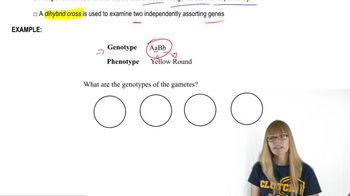
Gamete Genetics and Independent Assortment

Biochemical Pathway and Epistasis

The biochemical pathway shows a sequential conversion from colorless to yellow, green, and speckled flowers, controlled by genes A, B, and C respectively. Mutations in any gene can block the pathway, causing epistasis where one gene's effect masks others, influencing the final flower color phenotype.
Recommended video:
Guided course
05:44
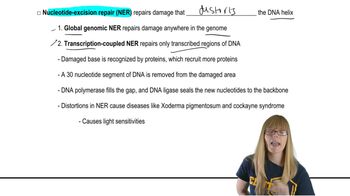
Repair Pathways

Genotypic and Phenotypic Ratios in F1 and F2 Generations

Crossing true-breeding parents with different homozygous genotypes produces predictable F1 heterozygotes. The F2 generation, from self-crossing F1, shows segregation and recombination of alleles, resulting in various genotypic and phenotypic ratios based on Mendelian inheritance and the biochemical pathway.
Recommended video:
Guided course
13:40
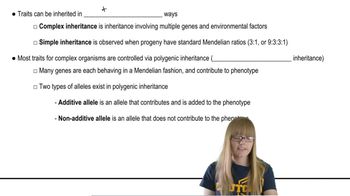
Traits and Variance
Related Practice
Textbook Question

How does an enzyme function? Why are enzymes essential for living organisms on Earth?

717
views
Textbook Question

Several amino acid substitutions in the α and β chains of human hemoglobin are shown in the following table.

Using the code table, determine how many of them can occur as a result of a single-nucleotide change.

759
views
Textbook Question

Three independently assorting genes (A, B, and C) are known to control the following biochemical pathway that provides the basis for flower color in a hypothetical plant:

Three homozygous recessive mutations are also known, each of which interrupts a different one of these steps. Determine the phenotypic results in the F1 and F2 generations resulting from the P1 crosses of true-breeding plants listed here:

speckled (AABBCC) × yellow (AAbbCC)

845
views
Textbook Question

Three independently assorting genes (A, B, and C) are known to control the following biochemical pathway that provides the basis for flower color in a hypothetical plant:

Three homozygous recessive mutations are also known, each of which interrupts a different one of these steps. Determine the phenotypic results in the F1 and F2 generations resulting from the P1 crosses of true-breeding plants listed here:

colorless (aaBBCC) × green (AABBcc)

676
views
Textbook Question

How would the results vary in cross (a) of Problem 32 if genes A and B were linked with no crossing over between them? How would the results of cross (a) vary if genes A and B were linked and 20 map units (mu) apart?

758
views