Pearson+ LogoPearson+ Logo
Ch. 16 - Regulation of Gene Expression in Eukaryotes
Klug - Essentials of Genetics 10th Edition
Klug10th EditionEssentials of GeneticsISBN: 9780135588789Not the one you use?Change textbook
Chapter 16, Problem 4

Describe the organization of the interphase nucleus. Include in your presentation a description of chromosome territories and interchromatin compartments.

Verified step by step guidance
1
Begin by explaining that the interphase nucleus is the phase of the cell cycle when the cell is not dividing, and the chromatin is less condensed compared to mitosis, allowing for active gene expression and DNA replication.
Describe that within the interphase nucleus, chromosomes are organized into distinct regions called chromosome territories, where each chromosome occupies a specific, non-overlapping space.
Explain that chromosome territories help maintain the spatial organization of the genome, facilitating regulated gene expression and efficient DNA repair.
Introduce the concept of interchromatin compartments, which are the spaces between chromosome territories filled with a network of proteins and RNA, serving as sites for transcription, RNA processing, and other nuclear activities.
Summarize by highlighting that the interphase nucleus is a highly organized structure where chromosome territories and interchromatin compartments work together to regulate nuclear functions and maintain genome integrity.

Key Concepts

Here are the essential concepts you must grasp in order to answer the question correctly.

Interphase Nucleus Organization

The interphase nucleus is the cell nucleus during the non-dividing phase, where DNA is less condensed than in mitosis. It contains chromatin organized into distinct regions, allowing for regulated gene expression and DNA replication. The spatial arrangement within the nucleus is non-random and crucial for cellular function.
Recommended video:
Guided course
09:12
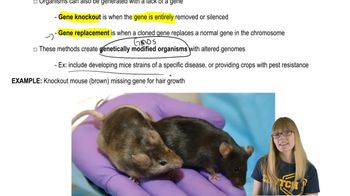
Transgenic Organisms and Gene Therapy

Chromosome Territories

Chromosome territories are distinct, non-overlapping regions within the interphase nucleus occupied by individual chromosomes. Each chromosome maintains a specific territory, which helps organize the genome spatially and influences gene regulation by controlling interactions between different chromosomal regions.
Recommended video:
Guided course
07:10
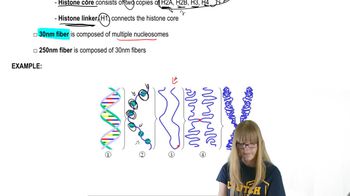
Chromosome Structure

Interchromatin Compartments

Interchromatin compartments are the spaces between chromosome territories filled with a network of proteins and RNA. These compartments facilitate molecular trafficking, RNA processing, and the organization of nuclear bodies, playing a key role in regulating gene expression and maintaining nuclear architecture.
Recommended video:
Guided course
03:49
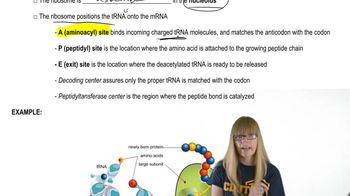
Ribosome Structure