Ch. 16 - Regulation of Gene Expression in Eukaryotes

Klug10th EditionEssentials of GeneticsISBN: 9780135588789
Not the one you use?Change textbookSelect a different textbook
Table of contents
- Ch. 1 - Introduction to Genetics16
- Ch. 2 - Mitosis and Meiosis28
- Ch. 3 - Mendelian Genetics37
- Ch. 4 - Modification of Mendelian Ratios53
- Ch. 5 - Sex Determination and Sex Chromosomes32
- Ch. 6 - Chromosome Mutations: Variation in Number and Arrangement37
- Ch. 7 - Linkage and Chromosome Mapping in Eukaryotes36
- Ch. 8 - Genetic Analysis and Mapping in Bacteria and Bacteriophages24
- Ch. 9 - DNA Structure and Analysis38
- Ch. 10 - DNA Replication29
- Ch. 11 - Chromosome Structure and DNA Sequence Organization22
- Ch. 12 - The Genetic Code and Transcription36
- Ch. 13 - Translation and Proteins27
- Ch. 14 - Gene Mutation, DNA Repair, and Transposition34
- Ch. 15 - Regulation of Gene Expression in Bacteria22
- Ch. 16 - Regulation of Gene Expression in Eukaryotes37
- Ch. 17 - Recombinant DNA Technology27
- Ch. 18 - Genomics, Bioinformatics, and Proteomics30
- Ch. 19 - The Genetics of Cancer21
- Ch. 20 - Quantitative Genetics and Multifactorial Traits37
- Ch. 21 - Population and Evolutionary Genetics45

Chapter 16, Problem 24
How is it possible that a given mRNA in a cell is found throughout the cytoplasm but the protein that it encodes is only found in a few specific regions?
 Verified step by step guidance
1
Understand that mRNA molecules can be distributed widely throughout the cytoplasm after transcription, allowing them to be present in many parts of the cell.
Recognize that the localization of the protein product depends not only on where the mRNA is but also on post-translational mechanisms that control where the protein accumulates or functions.
Consider that proteins often have specific signal sequences or domains that direct them to particular cellular compartments or regions, which restricts their final location despite widespread mRNA distribution.
Acknowledge that protein localization can also be influenced by interactions with other cellular structures, such as the cytoskeleton or membrane-bound organelles, which help concentrate the protein in specific areas.
Finally, understand that localized protein degradation or modification can further refine the spatial distribution of the protein, ensuring it is only present in certain regions even if the mRNA is everywhere.
Key Concepts
Here are the essential concepts you must grasp in order to answer the question correctly.
mRNA Localization and Transport
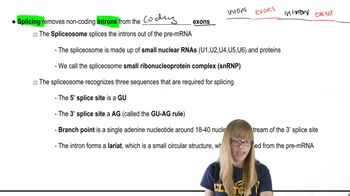
mRNA molecules can be distributed throughout the cytoplasm, but their localization is often regulated by cellular mechanisms. Specific sequences within the mRNA, called localization signals, direct the transport and anchoring of mRNA to particular regions, influencing where translation occurs.
Recommended video:
Guided course
 08:39
08:39
mRNA Processing
Localized Translation
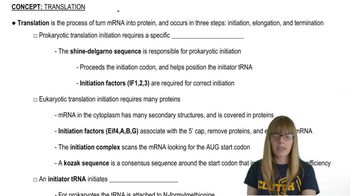
Even if mRNA is widespread, translation into protein can be spatially controlled. Cells can restrict the initiation of translation to certain areas, ensuring that proteins are synthesized only where needed, which helps in cellular organization and function.
Recommended video:
Guided course
 07:58
07:58Translation initiation
Protein Targeting and Anchoring
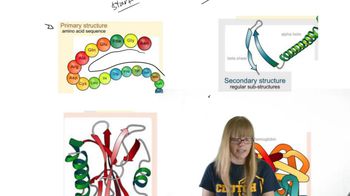
After synthesis, proteins may be transported or anchored to specific cellular locations. Post-translational modifications or interactions with other cellular structures can confine proteins to particular regions, explaining why proteins appear localized despite widespread mRNA.
Recommended video:
Guided course
 05:05
05:05Proteins
Related Practice