Ch. 16 - Regulation of Gene Expression in Eukaryotes

Klug10th EditionEssentials of GeneticsISBN: 9780135588789
Not the one you use?Change textbookSelect a different textbook
Table of contents
- Ch. 1 - Introduction to Genetics16
- Ch. 2 - Mitosis and Meiosis28
- Ch. 3 - Mendelian Genetics37
- Ch. 4 - Modification of Mendelian Ratios53
- Ch. 5 - Sex Determination and Sex Chromosomes32
- Ch. 6 - Chromosome Mutations: Variation in Number and Arrangement37
- Ch. 7 - Linkage and Chromosome Mapping in Eukaryotes36
- Ch. 8 - Genetic Analysis and Mapping in Bacteria and Bacteriophages24
- Ch. 9 - DNA Structure and Analysis38
- Ch. 10 - DNA Replication29
- Ch. 11 - Chromosome Structure and DNA Sequence Organization22
- Ch. 12 - The Genetic Code and Transcription36
- Ch. 13 - Translation and Proteins27
- Ch. 14 - Gene Mutation, DNA Repair, and Transposition34
- Ch. 15 - Regulation of Gene Expression in Bacteria22
- Ch. 16 - Regulation of Gene Expression in Eukaryotes37
- Ch. 17 - Recombinant DNA Technology27
- Ch. 18 - Genomics, Bioinformatics, and Proteomics30
- Ch. 19 - The Genetics of Cancer21
- Ch. 20 - Quantitative Genetics and Multifactorial Traits37
- Ch. 21 - Population and Evolutionary Genetics45

Chapter 16, Problem 20
miRNAs target endogenous mRNAs in a sequence-specific manner. Explain, conceptually, how one might identify potential mRNA targets for a given miRNA if you only know the sequence of the miRNA and the sequence of all mRNAs in a cell or tissue of interest.
 Verified step by step guidance
1
Understand that miRNAs regulate gene expression by binding to complementary sequences in target mRNAs, usually within the 3' untranslated region (3' UTR), leading to mRNA degradation or translational repression.
Identify the 'seed region' of the miRNA, which is typically nucleotides 2 to 8 from the 5' end; this region is critical for target recognition and binding specificity.
Scan the sequences of all mRNAs in the cell or tissue for complementary matches to the miRNA seed region, focusing on perfect or near-perfect base pairing, especially in the 3' UTR regions.
Consider additional factors that influence miRNA-mRNA interactions, such as the accessibility of the target site (secondary structure of mRNA), evolutionary conservation of the target site across species, and the presence of multiple binding sites for the same miRNA on a single mRNA.
Use computational tools or algorithms that integrate these criteria to predict potential miRNA targets by ranking mRNAs based on the strength and likelihood of interaction with the given miRNA sequence.
Key Concepts
Here are the essential concepts you must grasp in order to answer the question correctly.
miRNA-mRNA Base Pairing
miRNAs regulate gene expression by binding to complementary sequences on target mRNAs, typically within the 3' untranslated region. This binding is sequence-specific, relying on Watson-Crick base pairing, especially in the miRNA seed region (nucleotides 2-8). Identifying potential targets involves finding mRNAs with complementary sequences to the miRNA seed region.
Recommended video:
Guided course

 03:49
03:49
Base Distortions
Bioinformatic Target Prediction
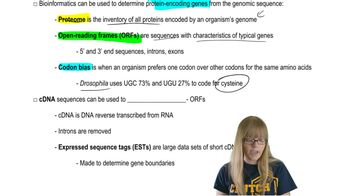
Computational tools scan mRNA sequences to find regions complementary to the miRNA, focusing on seed matches and thermodynamic stability. Algorithms also consider evolutionary conservation and site accessibility to improve prediction accuracy. This approach allows systematic identification of candidate mRNA targets from large sequence datasets.
Recommended video:
Guided course
 08:28
08:28Bioinformatics
Functional Validation of Targets
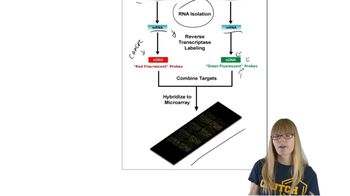
Predicted miRNA-mRNA interactions require experimental validation to confirm biological relevance. Techniques like reporter assays, mutagenesis of target sites, and expression analysis help verify if binding affects mRNA stability or translation. This step ensures that computational predictions correspond to functional regulation in the cell.
Recommended video:
Guided course
 08:26
08:26Functional Genomics
Related Practice