Ch. 16 - Regulation of Gene Expression in Eukaryotes

Klug10th EditionEssentials of GeneticsISBN: 9780135588789
Not the one you use?Change textbookSelect a different textbook
Table of contents
- Ch. 1 - Introduction to Genetics16
- Ch. 2 - Mitosis and Meiosis28
- Ch. 3 - Mendelian Genetics37
- Ch. 4 - Modification of Mendelian Ratios53
- Ch. 5 - Sex Determination and Sex Chromosomes32
- Ch. 6 - Chromosome Mutations: Variation in Number and Arrangement37
- Ch. 7 - Linkage and Chromosome Mapping in Eukaryotes36
- Ch. 8 - Genetic Analysis and Mapping in Bacteria and Bacteriophages24
- Ch. 9 - DNA Structure and Analysis38
- Ch. 10 - DNA Replication29
- Ch. 11 - Chromosome Structure and DNA Sequence Organization22
- Ch. 12 - The Genetic Code and Transcription36
- Ch. 13 - Translation and Proteins27
- Ch. 14 - Gene Mutation, DNA Repair, and Transposition34
- Ch. 15 - Regulation of Gene Expression in Bacteria22
- Ch. 16 - Regulation of Gene Expression in Eukaryotes37
- Ch. 17 - Recombinant DNA Technology27
- Ch. 18 - Genomics, Bioinformatics, and Proteomics30
- Ch. 19 - The Genetics of Cancer21
- Ch. 20 - Quantitative Genetics and Multifactorial Traits37
- Ch. 21 - Population and Evolutionary Genetics45

Chapter 16, Problem 28b
The TBX20 transcription factor is important for the development of heart tissue. Deletion of the Tbx20 gene in mice results in poor heart development and the death of mice well before birth. To better understand how TBX20 regulates heart development at a genetic level, Sakabe et al. (2012. Hum. Mol. Genet. 21:2194–2204) performed a transcriptome analysis in which they compared the levels of all mRNAs between heart cells from wild-type mice and mice with Tbx20 deleted.
This study concluded that TBX20 acts as an activator of some genes but a repressor of other genes in cardiac tissue. How might a single transcription factor have opposite effects on the transcription of different genes?
 Verified step by step guidance
1
Understand that transcription factors can regulate gene expression by binding to specific DNA sequences near target genes, influencing the recruitment of RNA polymerase and other transcription machinery.
Recognize that a single transcription factor like TBX20 can interact with different co-factors or protein partners in the cell, which can modulate its activity to either activate or repress transcription depending on the context.
Consider that the local chromatin environment and the presence of other regulatory elements (such as enhancers or silencers) near different genes can influence whether TBX20 acts as an activator or repressor.
Acknowledge that TBX20 might recruit co-activators (which promote transcription) at some gene loci and co-repressors (which inhibit transcription) at others, leading to opposite effects on gene expression.
Summarize that the dual role of TBX20 arises from its ability to integrate multiple molecular signals and interact with diverse protein complexes, resulting in gene-specific regulation during heart development.
Key Concepts
Here are the essential concepts you must grasp in order to answer the question correctly.
Transcription Factors and Gene Regulation
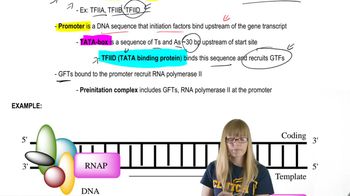
Transcription factors are proteins that bind specific DNA sequences to regulate gene expression. They can either activate or repress transcription by recruiting or blocking the transcriptional machinery. Their effect depends on the context of the target gene and interacting cofactors.
Recommended video:
Guided course
 09:16
09:16
Eukaryotic Transcription
Context-Dependent Function of Transcription Factors
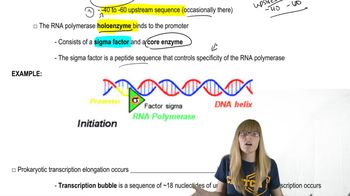
A single transcription factor can act as an activator or repressor depending on the presence of co-activators or co-repressors, the DNA binding site, and chromatin environment. These interactions modulate whether the transcription factor promotes or inhibits gene expression.
Recommended video:
Guided course
 10:14
10:14Prokaryotic Transcription
Transcriptome Analysis for Gene Expression Profiling
Transcriptome analysis measures the levels of all mRNAs in a cell or tissue, allowing comparison between different conditions. This approach helps identify genes that are upregulated or downregulated due to factors like transcription factor deletion, revealing their regulatory roles.
Recommended video:
Guided course
 02:09
02:09Penetrance and Expressivity
Related Practice