If a cell suffers damage to its DNA while in S phase, how can this damage be repaired before the cell enters mitosis?
Ch. 19 - The Genetics of Cancer
Chapter 19, Problem 14
Of the two classes of genes associated with cancer, tumor-suppressor genes and oncogenes, mutations in which group can be considered gain-of-function mutations? In which group are the loss-of-function mutations? Explain.
Verified step by step guidance1
Understand the two classes of genes associated with cancer: tumor-suppressor genes and oncogenes. Tumor-suppressor genes normally act to inhibit cell division or promote apoptosis, preventing uncontrolled cell growth. Oncogenes, on the other hand, promote cell division and survival when activated.
Recall the definitions of gain-of-function and loss-of-function mutations. Gain-of-function mutations result in a gene product with enhanced or new activity, while loss-of-function mutations reduce or eliminate the normal activity of the gene product.
Analyze oncogenes: mutations in oncogenes typically lead to gain-of-function, meaning the mutated gene is overactive or constitutively active, driving excessive cell proliferation. This is because oncogenes are like the 'gas pedal' for cell growth.
Analyze tumor-suppressor genes: mutations here are usually loss-of-function, meaning the gene loses its ability to regulate or inhibit cell growth. This loss removes the 'brakes' on cell division, allowing uncontrolled growth.
Summarize that gain-of-function mutations are characteristic of oncogenes, while loss-of-function mutations are characteristic of tumor-suppressor genes, explaining their roles in cancer development.

Verified video answer for a similar problem:
This video solution was recommended by our tutors as helpful for the problem above.
Video duration:
2mWas this helpful?
Key Concepts
Here are the essential concepts you must grasp in order to answer the question correctly.
Oncogenes and Gain-of-Function Mutations
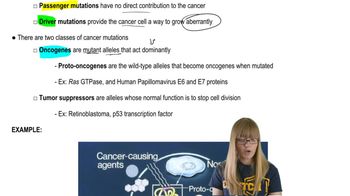
Oncogenes are mutated forms of proto-oncogenes that promote cell growth and division. Gain-of-function mutations in these genes lead to their overactivation or constant activity, driving uncontrolled cell proliferation and contributing to cancer development.
Recommended video:
Guided course
Functional Genomics
Tumor-Suppressor Genes and Loss-of-Function Mutations
Tumor-suppressor genes normally inhibit cell growth or promote apoptosis to prevent tumor formation. Loss-of-function mutations in these genes disable their protective roles, allowing cells to grow unchecked and increasing cancer risk.
Recommended video:
Guided course
Cancer Mutations
Difference Between Gain- and Loss-of-Function Mutations
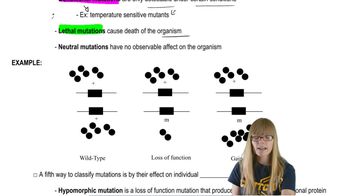
Gain-of-function mutations enhance or create new gene activity, often dominant in oncogenes, while loss-of-function mutations reduce or eliminate gene activity, typically recessive in tumor-suppressor genes. Understanding this distinction is key to grasping how different gene classes contribute to cancer.
Recommended video:
Guided course
Mutations and Phenotypes
Related Practice
Textbook Question
557
views
Textbook Question
Distinguish between oncogenes and proto-oncogenes. In what ways can proto-oncogenes be converted to oncogenes?
890
views
Textbook Question
How do translocations such as the Philadelphia chromosome contribute to cancer?
770
views
Textbook Question
How do normal cells protect themselves from accumulating mutations in genes that could lead to cancer? How do cancer cells differ from normal cells in these processes?
406
views
Textbook Question
Radiotherapy (treatment with ionizing radiation) is one of the most effective current cancer treatments. It works by damaging DNA and other cellular components. In which ways could radiotherapy control or cure cancer, and why does radiotherapy often have significant side effects?
513
views