Pearson+ LogoPearson+ Logo
Ch. 20 - Quantitative Genetics and Multifactorial Traits
Klug - Essentials of Genetics 10th Edition
Klug10th EditionEssentials of GeneticsISBN: 9780135588789Not the one you use?Change textbook
Chapter 20, Problem 12

What advantages do cDNA libraries provide over genomic DNA libraries? Describe cloning applications where the use of a genomic library is necessary to provide information that a cDNA library cannot.

Verified step by step guidance
1
Understand the nature of cDNA libraries: cDNA libraries are made from mRNA transcripts that have been reverse-transcribed into complementary DNA (cDNA). This means they represent only the expressed genes in a particular tissue or cell type at the time of RNA extraction, and they lack introns and non-coding regions.
Recognize the advantages of cDNA libraries: Since cDNA libraries contain only coding sequences (exons), they are useful for studying gene expression, producing recombinant proteins, and identifying coding sequences without introns, which simplifies cloning and expression in prokaryotic systems.
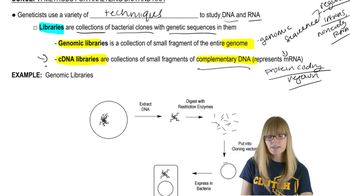
Understand the nature of genomic DNA libraries: Genomic libraries contain fragments of the entire genome, including coding regions, introns, regulatory sequences, and intergenic regions. They represent the complete genetic content of an organism.
Identify cloning applications requiring genomic libraries: When studying gene regulation, intron-exon structure, promoter regions, or non-coding DNA elements, a genomic library is necessary because cDNA libraries lack these sequences. Also, for organisms with alternative splicing or unknown gene structures, genomic libraries provide the full context.
Summarize the complementary uses: Use cDNA libraries to analyze expressed genes and produce proteins, and use genomic libraries to investigate gene structure, regulatory elements, and genomic organization that cDNA libraries cannot provide.

Verified video answer for a similar problem:

This video solution was recommended by our tutors as helpful for the problem above.
Video duration:
1m
Was this helpful?

Key Concepts

Here are the essential concepts you must grasp in order to answer the question correctly.

cDNA Libraries

cDNA libraries are collections of complementary DNA sequences synthesized from mRNA transcripts, representing only the expressed genes in a cell at a given time. They exclude non-coding regions like introns and regulatory sequences, making them useful for studying gene expression and producing protein-coding sequences.
Recommended video:
Guided course
07:40
Methods for Analyzing DNA and RNA

Genomic DNA Libraries

Genomic DNA libraries contain fragments of an organism's entire genome, including coding regions, introns, regulatory elements, and intergenic sequences. They provide a comprehensive representation of all genetic material, which is essential for studying gene structure, regulatory sequences, and non-expressed regions.
Recommended video:
Guided course
09:28
Genomic Variation

Applications Requiring Genomic Libraries

Genomic libraries are necessary when information about gene regulation, intron-exon structure, or non-coding DNA is required. They are crucial for cloning entire genes with regulatory elements, studying mutations in non-coding regions, or analyzing genome organization, which cDNA libraries cannot provide due to their focus on expressed sequences only.
Recommended video:
Guided course
08:26
Functional Genomics
Related Practice
Textbook Question

What kind of heritability estimates (broad sense or narrow sense) are obtained from human twin studies?

1190
views
Textbook Question

List as many human traits as you can that are likely to be under the control of a polygenic mode of inheritance.

461
views
Textbook Question

In a cross between a strain of large guinea pigs and a strain of small guinea pigs, the F₁ are phenotypically uniform, with an average size about intermediate between that of the two parental strains. Among 1014 F₂ individuals, 3 are about the same size as the small parental strain and 5 are about the same size as the large parental strain. How many gene pairs are involved in the inheritance of size in these strains of guinea pigs?

529
views
Textbook Question

Corn plants from a test plot are measured, and the distribution of heights at 10-cm intervals is recorded in the following table: 

 Height (cm)   Plants (no.)    

100          20    

110          60    

120          90    

130         130    

140         180   

 150         120    

160          70    

170         50    

180         40 

Calculate 

(a) the mean height, 

(b) the variance, 

(c) the standard deviation, and 

(d) the standard error of the mean. 

Plot a rough graph of plant height against frequency. Do the values represent a normal distribution? Based on your calculations, how would you assess the variation within this population?

940
views
Textbook Question

The following variances were calculated for two traits in a herd of hogs.

Calculate broad-sense () and narrow-sense () heritabilities for each trait in this herd.

520
views
Textbook Question

The following variances were calculated for two traits in a herd of hogs.

Which of the two traits will respond best to selection by a breeder? Why?

557
views