
In an assessment of learning in Drosophila, flies were trained to avoid certain olfactory cues. In one population, a mean of 8.5 trials was required. A subgroup of this parental population that was trained most quickly (mean=6.0) was interbred, and their progeny were examined. These flies demonstrated a mean training value of 7.5. Calculate realized heritability for olfactory learning in Drosophila.
Ch. 20 - Quantitative Genetics and Multifactorial Traits
Chapter 20, Problem 20
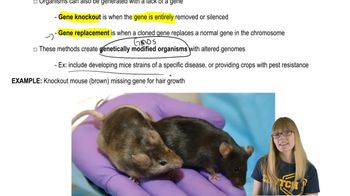
What techniques can scientists use to determine if a particular transgene has been integrated into the genome of an organism?
Verified step by step guidance1
Understand that a transgene is a gene that has been transferred from one organism into the genome of another, and scientists need to confirm its presence and integration into the host genome.
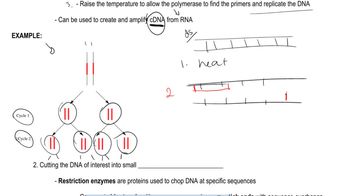
Use Polymerase Chain Reaction (PCR) to amplify specific DNA sequences of the transgene. Design primers that match the transgene sequence and perform PCR on the organism's DNA to check for the presence of the transgene.
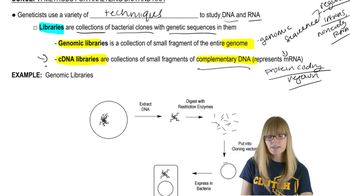
Perform Southern blot analysis to detect the integration and copy number of the transgene. This involves digesting genomic DNA with restriction enzymes, separating fragments by gel electrophoresis, transferring them to a membrane, and hybridizing with a labeled probe specific to the transgene.
Use Fluorescence In Situ Hybridization (FISH) to visualize the physical location of the transgene on chromosomes. This technique uses fluorescently labeled probes that bind to the transgene sequence in chromosome spreads.
Consider using quantitative PCR (qPCR) or digital droplet PCR to estimate the copy number of the transgene, or sequencing methods to confirm the exact integration site and sequence integrity.

Verified video answer for a similar problem:
This video solution was recommended by our tutors as helpful for the problem above.
Video duration:
2mWas this helpful?
Key Concepts
Here are the essential concepts you must grasp in order to answer the question correctly.
Transgene Integration
Transgene integration refers to the insertion of foreign DNA into an organism's genome. Understanding this process is essential because it determines whether the introduced gene is stably incorporated and can be inherited by subsequent generations.
Recommended video:
Guided course
Transgenic Organisms and Gene Therapy
Polymerase Chain Reaction (PCR)
PCR is a molecular technique used to amplify specific DNA sequences. Scientists use PCR to detect the presence of a transgene by designing primers that target the inserted gene, allowing rapid and sensitive identification of transgene integration.
Recommended video:
Guided course
Genetic Cloning
Southern Blotting
Southern blotting is a method for detecting specific DNA sequences within a genome. It involves DNA digestion, gel electrophoresis, transfer to a membrane, and hybridization with a labeled probe, enabling confirmation of transgene integration and copy number.
Recommended video:
Guided course
Methods for Analyzing DNA and RNA
Related Practice
Textbook Question
435
views
Textbook Question
Suppose you want to develop a population of Drosophila that would rapidly learn to avoid certain substances the flies could detect by smell. Based on the heritability estimate you obtained in Problem 16, do you think it would be worth doing this by artificial selection? Why or why not?
467
views
Textbook Question
In a population of tomato plants, mean fruit weight is 60 g and h² is 0.3. Predict the mean weight of the progeny if tomato plants whose fruit averaged 80 g were selected from the original population and interbred.
425
views
Textbook Question
In a population of 100 inbred, genotypically identical rice plants, variance for grain yield is 4.67. What is the heritability for yield? Would you advise a rice breeder to improve yield in this strain of rice plants by selection?
720
views
