
Pearson+ LogoPearson+ Logo
Ch. 3 - Mendelian Genetics
Klug - Essentials of Genetics 10th Edition
Klug10th EditionEssentials of GeneticsISBN: 9780135588789Not the one you use?Change textbook
Chapter 3, Problem 16

In assessing data that fell into two phenotypic classes, a geneticist observed values of 250:150. She decided to perform a χ\chi² analysis by using the following two different null hypotheses:
(a) the data fit a 3:1 ratio, and
(b) the data fit a 1:1 ratio.
Calculate the χ\chi ² values for each hypothesis. What can be concluded about each hypothesis?

Verified step by step guidance
1
Step 1: Identify the observed values and total number of observations. Here, the observed counts are 250 and 150, so the total is 250 + 150 = 400.
Step 2: For hypothesis (a), where the expected ratio is 3:1, calculate the expected counts by dividing the total according to this ratio. The expected count for the first class is \(\frac{3}{4} \times 400\), and for the second class is \(\frac{1}{4} \times 400\).
Step 3: For hypothesis (b), where the expected ratio is 1:1, calculate the expected counts by dividing the total equally. Each class is expected to have \(\frac{1}{2} \times 400\) individuals.
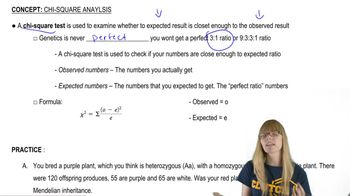
Step 4: Use the chi-square formula to calculate the chi-square value for each hypothesis: \(\chi^{2} = \sum \frac{(O - E)^2}{E}\) where \(O\) is the observed count and \(E\) is the expected count for each phenotypic class. Calculate this sum separately for each hypothesis using their respective expected counts.
Step 5: Compare the calculated chi-square values to the critical chi-square value from the chi-square distribution table at the appropriate degrees of freedom (df = number of classes - 1) and significance level (commonly 0.05). If the calculated value is less than the critical value, the hypothesis fits the data well; if greater, the hypothesis is rejected.

Verified video answer for a similar problem:

This video solution was recommended by our tutors as helpful for the problem above.
Video duration:
1m
Was this helpful?

Key Concepts

Here are the essential concepts you must grasp in order to answer the question correctly.

Chi-Square (χ²) Test

The chi-square test is a statistical method used to compare observed data with expected data based on a specific hypothesis. It calculates a χ² value that measures the difference between observed and expected frequencies. A higher χ² value indicates a greater deviation from the expected ratio, helping to determine if the null hypothesis can be rejected.
Recommended video:
Guided course
02:48
Chi Square Analysis

Null Hypothesis in Genetic Ratios

In genetics, the null hypothesis often states that observed phenotypic ratios fit a predicted Mendelian ratio, such as 3:1 or 1:1. This hypothesis assumes no significant difference between observed and expected data. Testing different null hypotheses helps identify which genetic model best explains the observed data.
Recommended video:
Guided course
03:13
Translation:Wobble Hypothesis

Interpreting Chi-Square Results

After calculating the χ² value, it is compared to a critical value from the chi-square distribution table based on degrees of freedom and significance level. If χ² is less than the critical value, the null hypothesis is accepted; if greater, it is rejected. This interpretation determines whether observed deviations are due to chance or indicate a different genetic pattern.
Recommended video:
Guided course
02:48
Chi Square Analysis