The basis for rejecting any null hypothesis is arbitrary. The researcher can set more or less stringent standards by deciding to raise or lower the p value used to reject or not reject the hypothesis. In the case of the chi-square analysis of genetic crosses, would the use of a standard of p = 0.10 be more or less stringent about not rejecting the null hypothesis? Explain.
Ch. 3 - Mendelian Genetics
Chapter 3, Problem 20
Of all offspring of the parents in Problem 18, what proportion will express all three dominant traits?
Verified step by step guidance1
Identify the genotypes of the parents from Problem 18, including the alleles for all three traits. This is essential to determine the possible gametes each parent can produce.
Determine the mode of inheritance for each trait (e.g., complete dominance) and write down the possible allele combinations for each trait in the offspring using a Punnett square or the multiplication rule.
Calculate the probability that an offspring will inherit the dominant allele for each of the three traits individually. For each trait, this is typically the sum of the probabilities of genotypes that include at least one dominant allele.
Multiply the individual probabilities of expressing the dominant phenotype for each of the three traits together, because the traits are inherited independently (assuming independent assortment). This gives the proportion of offspring expressing all three dominant traits.
Express the final answer as a fraction or decimal representing the proportion of offspring expected to show all three dominant traits.
Key Concepts
Here are the essential concepts you must grasp in order to answer the question correctly.
Mendelian Inheritance and Dominant Traits
Mendelian inheritance explains how traits are passed from parents to offspring through dominant and recessive alleles. A dominant trait is expressed when at least one dominant allele is present. Understanding which alleles are dominant is essential to predict the phenotype ratios in offspring.
Recommended video:
Guided course
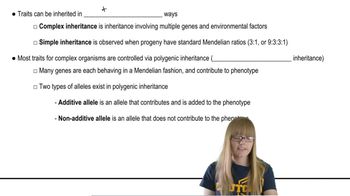
Traits and Variance
Probability in Genetic Crosses
Calculating the proportion of offspring with specific traits involves using probability rules, especially when multiple traits are considered. The probability of independent events occurring together is the product of their individual probabilities, which helps determine the likelihood of offspring expressing all dominant traits.
Recommended video:
Guided course
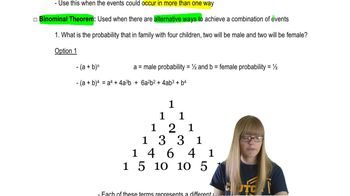
Probability
Dihybrid and Trihybrid Crosses
Trihybrid crosses involve three gene pairs, each with dominant and recessive alleles. Understanding how to set up and analyze these crosses using Punnett squares or probability helps predict the distribution of genotypes and phenotypes, including the proportion of offspring expressing all dominant traits.
Recommended video:
Guided course
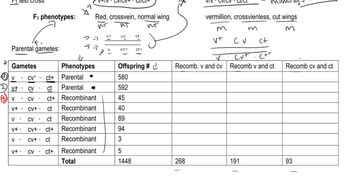
Trihybrid Cross
Related Practice
Textbook Question
813
views
Textbook Question
Consider the following pedigree.
Predict the mode of inheritance of the trait of interest and the most probable genotype of each individual. Assume that the alleles A and a control the expression.
4334
views
1
rank
Textbook Question
Draw all possible conclusions concerning the mode of inheritance of the trait portrayed in the following limited pedigree.
1084
views
Textbook Question
Draw all possible conclusions concerning the mode of inheritance of the trait portrayed in the following limited pedigree.
1091
views