Pearson+ LogoPearson+ Logo
Ch. 3 - Mendelian Genetics
Klug - Essentials of Genetics 10th Edition
Klug10th EditionEssentials of GeneticsISBN: 9780135588789Not the one you use?Change textbook
Chapter 3, Problem 23a

Two true-breeding pea plants are crossed. One parent is round, terminal, violet, constricted, while the other expresses the contrasting phenotypes of wrinkled, axial, white, full. The four pairs of contrasting traits are controlled by four genes, each located on a separate chromosome. In the F1 generation, only round, axial, violet, and full are expressed. In the F2 generation, all possible combinations of these traits are expressed in ratios consistent with Mendelian inheritance.
What conclusion can you draw about the inheritance of these traits based on the F1 results?

Verified step by step guidance
1
Identify the parental genotypes based on the given phenotypes. Since the parents are true-breeding, one parent is homozygous for round, terminal, violet, and constricted traits, and the other is homozygous for wrinkled, axial, white, and full traits.
Determine the dominant and recessive traits by examining the F\_1 generation phenotypes. The F\_1 plants express round, axial, violet, and full traits, indicating these are the dominant phenotypes.
Write the genotype of the F\_1 generation as heterozygous for all four genes, since they inherit one allele from each parent. For example, if R = round (dominant) and r = wrinkled (recessive), then the F\_1 genotype for that gene is Rr.
Understand that the expression of only the dominant traits in the F\_1 generation suggests simple Mendelian dominance for each gene, with no gene interactions or linkage affecting these traits.
Conclude that each trait is inherited independently and follows Mendel's law of dominance, where the dominant allele masks the recessive allele in the heterozygous F\_1 individuals.

Key Concepts

Here are the essential concepts you must grasp in order to answer the question correctly.

Mendelian Inheritance

Mendelian inheritance refers to the patterns of inheritance first described by Gregor Mendel, where traits are controlled by discrete genes with dominant and recessive alleles. In a monohybrid or dihybrid cross, dominant traits mask recessive ones in the F1 generation, and predictable phenotypic ratios appear in the F2 generation.
Recommended video:
Guided course
05:13
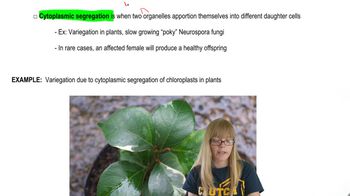
Organelle Inheritance

Dominance and Recessiveness

Dominance occurs when one allele masks the expression of another allele at the same gene locus. In this question, the F1 generation shows only round, axial, violet, and full traits, indicating these are dominant over wrinkled, terminal, white, and constricted, which are recessive.
Recommended video:
Guided course
04:37
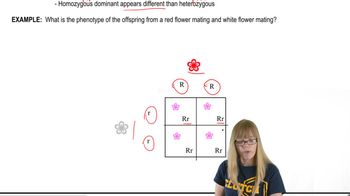
Variations on Dominance

Independent Assortment

Independent assortment is the principle that genes located on different chromosomes segregate independently during gamete formation. Since the four genes are on separate chromosomes, the F2 generation exhibits all possible trait combinations in Mendelian ratios, confirming independent assortment.
Recommended video:
Guided course
04:58
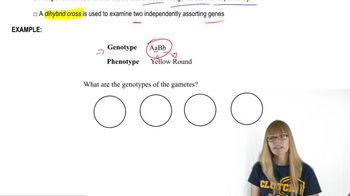
Gamete Genetics and Independent Assortment