Ch. 4 - Modification of Mendelian Ratios
Klug10th EditionEssentials of GeneticsISBN: 9780135588789
Not the one you use?Change textbookSelect a different textbook
Table of contents
- Ch. 1 - Introduction to Genetics16
- Ch. 2 - Mitosis and Meiosis28
- Ch. 3 - Mendelian Genetics37
- Ch. 4 - Modification of Mendelian Ratios53
- Ch. 5 - Sex Determination and Sex Chromosomes32
- Ch. 6 - Chromosome Mutations: Variation in Number and Arrangement37
- Ch. 7 - Linkage and Chromosome Mapping in Eukaryotes36
- Ch. 8 - Genetic Analysis and Mapping in Bacteria and Bacteriophages24
- Ch. 9 - DNA Structure and Analysis38
- Ch. 10 - DNA Replication29
- Ch. 11 - Chromosome Structure and DNA Sequence Organization22
- Ch. 12 - The Genetic Code and Transcription36
- Ch. 13 - Translation and Proteins27
- Ch. 14 - Gene Mutation, DNA Repair, and Transposition34
- Ch. 15 - Regulation of Gene Expression in Bacteria22
- Ch. 16 - Regulation of Gene Expression in Eukaryotes37
- Ch. 17 - Recombinant DNA Technology27
- Ch. 18 - Genomics, Bioinformatics, and Proteomics30
- Ch. 19 - The Genetics of Cancer21
- Ch. 20 - Quantitative Genetics and Multifactorial Traits37
- Ch. 21 - Population and Evolutionary Genetics45

Chapter 4, Problem 34
Below is a partial pedigree of hemophilia in the British Royal Family descended from Queen Victoria, who is believed to be the original 'carrier' in this pedigree.
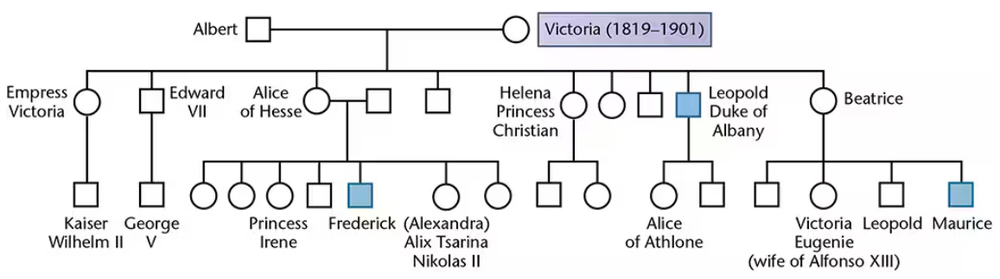
Analyze the pedigree and indicate which females are also certain to be carriers. What is the probability that Princess Irene is a carrier?
 Verified step by step guidance
1
Step 1: Understand the inheritance pattern of hemophilia. Hemophilia is an X-linked recessive disorder, meaning the gene causing hemophilia is located on the X chromosome. Males (XY) who inherit the affected X chromosome will express the disease, while females (XX) must inherit two affected X chromosomes to express the disease. Females with one affected X chromosome are carriers but typically do not show symptoms.
Step 2: Identify the original carrier. Queen Victoria is believed to be the original carrier, so she has one affected X chromosome (X^H) and one normal X chromosome (X). This means she can pass the affected X chromosome to her children.
Step 3: Determine which males are affected. In the pedigree, affected males are shown as filled squares. Since males inherit their X chromosome from their mother, any son of a carrier mother has a 50% chance of being affected. The presence of affected males in the descendants confirms that their mothers must be carriers.
Step 4: Identify females who are certain carriers. Any female who has an affected son must be a carrier because she must have passed the affected X chromosome to her son. Also, daughters of a carrier female have a 50% chance of being carriers. Use this logic to mark females who are certain carriers based on their affected sons or affected brothers.
Step 5: Calculate the probability that Princess Irene is a carrier. Since Princess Irene's mother is Alice of Hesse, who is a daughter of Queen Victoria, and considering whether Alice is a carrier or not, calculate the probability that Princess Irene inherited the affected X chromosome. This involves understanding the transmission probabilities from Queen Victoria to Alice, and then from Alice to Princess Irene.
Verified video answer for a similar problem:
This video solution was recommended by our tutors as helpful for the problem above.

Video duration:
5mWas this helpful?
Key Concepts
Here are the essential concepts you must grasp in order to answer the question correctly.
X-linked Recessive Inheritance
Hemophilia is an X-linked recessive disorder, meaning the gene causing the disease is located on the X chromosome. Males (XY) with the affected X chromosome express the disease, while females (XX) are typically carriers if they have one affected X and one normal X. Understanding this pattern helps identify carriers and affected individuals in a pedigree.
Recommended video:
Guided course
 09:30
09:30
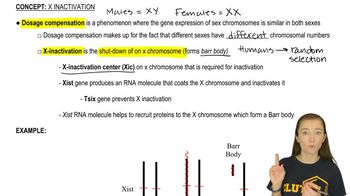
X-Inactivation
Carrier Females in X-linked Disorders
Carrier females have one normal and one mutated allele on their X chromosomes and usually do not show symptoms. They can pass the affected X chromosome to their offspring, with sons having a 50% chance of being affected and daughters a 50% chance of being carriers. Identifying carriers involves tracing inheritance through affected males and their mothers.
Recommended video:
Guided course
09:30X-Inactivation
Pedigree Analysis and Probability Calculation
Pedigree charts visually represent family relationships and inheritance patterns. By analyzing affected males and their maternal lineage, one can deduce which females must be carriers. Probability calculations for uncertain carriers, like Princess Irene, use known carrier statuses of relatives and Mendelian inheritance ratios to estimate the likelihood of carrier status.
Recommended video:
Guided course
 07:41
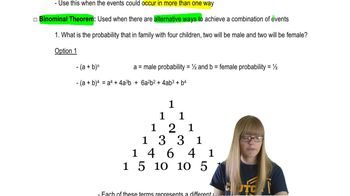
07:41Probability
Related Practice