
Pearson+ LogoPearson+ Logo
Ch. 4 - Modification of Mendelian Ratios
Klug - Essentials of Genetics 10th Edition
Klug10th EditionEssentials of GeneticsISBN: 9780135588789Not the one you use?Change textbook
Chapter 4, Problem 24a

Horses can be cremello (a light cream color), chestnut (a brownish color), or palomino (a golden color with white in the horse's tail and mane). Of these phenotypes, only palominos never breed true.
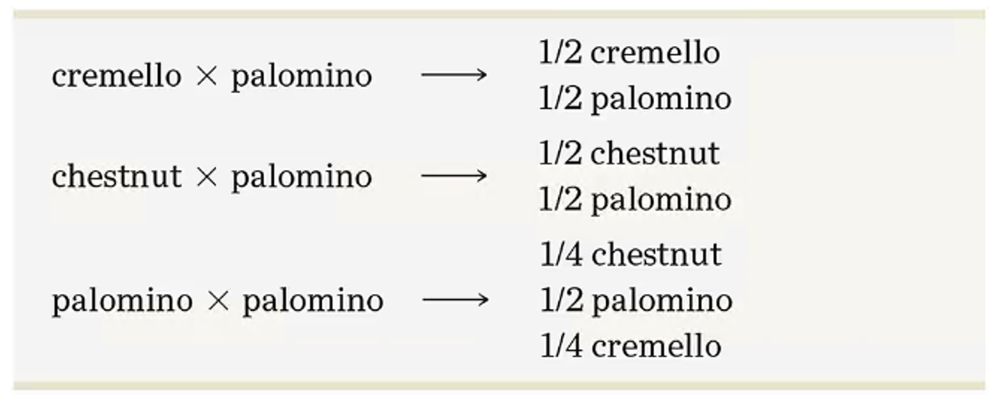
Breeding outcomes showing ratios of cremello, palomino, and chestnut horse phenotypes from different parental crosses.
From the results given above, determine the mode of inheritance by assigning gene symbols and indicating which genotypes yield which phenotypes.

Verified step by step guidance
1
Step 1: Define gene symbols for the alleles involved. Since the problem involves coat color with three phenotypes (cremello, palomino, chestnut), assign a gene symbol such as 'C' for the cream allele and 'c' for the non-cream allele. The cream allele is known to be incompletely dominant, so heterozygotes show the palomino phenotype.
Step 2: Assign genotypes to each phenotype based on the inheritance pattern. For example, 'CC' could represent cremello (homozygous cream), 'Cc' palomino (heterozygous cream), and 'cc' chestnut (no cream allele). This fits the description that palominos never breed true, as they are heterozygotes.
Step 3: Use the given breeding outcomes to confirm the genotypes. For instance, crossing cremello (CC) with palomino (Cc) yields 1/2 cremello (CC) and 1/2 palomino (Cc), matching the data. Similarly, chestnut (cc) crossed with palomino (Cc) yields 1/2 chestnut (cc) and 1/2 palomino (Cc).
Step 4: Analyze the palomino × palomino cross, which produces 1/2 palomino (Cc), 1/4 cremello (CC), and 1/4 chestnut (cc). This confirms the incomplete dominance pattern where heterozygotes show the intermediate phenotype (palomino).
Step 5: Summarize the mode of inheritance as incomplete dominance with the cream allele 'C' incompletely dominant over the non-cream allele 'c', resulting in three phenotypes: CC = cremello, Cc = palomino, and cc = chestnut.

Verified video answer for a similar problem:

This video solution was recommended by our tutors as helpful for the problem above.
Video duration:
1m
Was this helpful?

Key Concepts

Here are the essential concepts you must grasp in order to answer the question correctly.

Incomplete Dominance

Incomplete dominance occurs when heterozygous individuals display a phenotype that is intermediate between the two homozygous phenotypes. In this case, palomino horses represent the heterozygous phenotype, showing a blend of chestnut and cremello traits rather than one being completely dominant.
Recommended video:
Guided course
04:37
Variations on Dominance

Genotype-Phenotype Relationship

Understanding how specific genotypes correspond to observable phenotypes is crucial. Here, assigning gene symbols (e.g., C for cream allele and c for chestnut allele) helps explain the phenotypes: cremello (CC), chestnut (cc), and palomino (Cc), with palomino being heterozygous and showing an intermediate color.
Recommended video:
Guided course
07:52
Gamete Genotypes

Breeding Ratios and Predicting Offspring

Analyzing breeding outcomes and offspring ratios allows determination of inheritance patterns. The given crosses and resulting phenotypic ratios (e.g., 1/2 cremello and 1/2 palomino from cremello × palomino) support the incomplete dominance model and help predict genotypes and phenotypes of future generations.
Recommended video:
Guided course
08:06
Mendel's Experiments
Related Practice
Textbook Question

Consider the three pedigrees below, all involving a single human trait.

Given your conclusions in part (a), indicate the genotype of the following individuals: II-1, II-6, II-9 If more than one possibility applies, list all possibilities. Use the symbols A and a for the genotypes.

1023
views
Textbook Question

Labrador retrievers may be black, brown (chocolate), or golden (yellow) in color (see chapter-opening photo). While each color may breed true, many different outcomes are seen when numerous litters are examined from a variety of matings where the parents are not necessarily true breeding. Following are just some of the many possibilities.

(a) black x brown → all black

(b) black x brown → 1/2 black, 1/2 brown

(c) black x brown → 3/4 black, 1/4 golden

(d) black x golden → all black

(e) black x golden → 4/8 golden 3/8 black 1/8 brown

(f) black x golden → 2/4 golden 1/4 black 1/4 brown

(g) brown x brown → 3/4 brown 1/4 golden

(h) black x black → 9/16 black 4/16 golden, 3/16 brown

Propose a mode of inheritance that is consistent with these data, and indicate the corresponding genotypes of the parents in each mating. Indicate as well the genotypes of dogs that breed true for each color.

1012
views
Textbook Question

Horses can be cremello (a light cream color), chestnut (a brownish color), or palomino (a golden color with white in the horse's tail and mane). Of these phenotypes, only palominos never breed true.

Predict the F1 and F2 results of many initial matings between cremello and chestnut horses.

546
views
Textbook Question

Pigment in mouse fur is only produced when the C allele is present. Individuals of the cc genotype are white. If color is present, it may be determined by the A, a alleles. AA or Aa results in agouti color, while aa results in black coats. What F₁ and F₂ genotypic and phenotypic ratios are obtained from a cross between AACC and aacc mice?

751
views
Textbook Question

Pigment in mouse fur is only produced when the C allele is present. Individuals of the cc genotype are white. If color is present, it may be determined by the A, a alleles. AA or Aa results in agouti color, while aa results in black coats. In three crosses between agouti females whose genotypes were unknown and males of the aacc genotype, the following phenotypic ratios were obtained:

(1) 8 agouti

(2) 9 agouti

(3) 4 agouti, 8 white 10 black, 5 black, 10 white

1071
views