Pearson+ LogoPearson+ Logo
Ch. 4 - Modification of Mendelian Ratios
Klug - Essentials of Genetics 10th Edition
Klug10th EditionEssentials of GeneticsISBN: 9780135588789Not the one you use?Change textbook
Chapter 4, Problem 13

In cats, orange coat color is determined by the b allele, and black coat color is determined by the B allele. The heterozygous condition results in a coat pattern known as tortoiseshell. These genes are X-linked. What kinds of offspring would be expected from a cross of a black male and a tortoiseshell female? What are the chances of getting a tortoiseshell male?

Verified step by step guidance
1
Identify the genotypes of the parents based on the information given: The black male has genotype X\^B Y (since males have one X and one Y chromosome), and the tortoiseshell female has genotype X\^B X\^b (heterozygous for the B and b alleles).
Determine the possible gametes each parent can produce: The male can produce sperm carrying either X\^B or Y, and the female can produce eggs carrying either X\^B or X\^b.
Set up a Punnett square to combine the male and female gametes. The rows represent the male's gametes (X\^B and Y), and the columns represent the female's gametes (X\^B and X\^b).
Fill in the Punnett square to find the genotypes of the offspring: Combine each male gamete with each female gamete to get the possible genotypes of the offspring (X\^B X\^B, X\^B X\^b, X\^B Y, X\^b Y).
Interpret the genotypes in terms of coat color and sex: Females with X\^B X\^B are black, females with X\^B X\^b are tortoiseshell, males with X\^B Y are black, and males with X\^b Y are orange. Calculate the probability of each genotype, and specifically identify the chance of getting a tortoiseshell male (which is not possible because males have only one X chromosome).

Key Concepts

Here are the essential concepts you must grasp in order to answer the question correctly.

X-linked Inheritance

X-linked inheritance refers to genes located on the X chromosome. Males (XY) have only one X chromosome, so they express the allele present on it, while females (XX) have two X chromosomes and can be homozygous or heterozygous. This pattern affects how traits like coat color are passed and expressed differently in males and females.
Recommended video:
Guided course
09:30
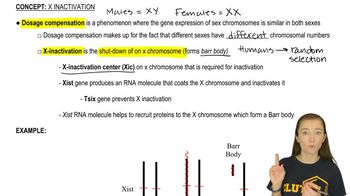
X-Inactivation

Alleles and Phenotypes in Coat Color

The B allele codes for black coat color, and the b allele codes for orange coat color in cats. Females heterozygous for these alleles (Bb) exhibit a tortoiseshell pattern due to X-chromosome inactivation, which causes patches of cells to express different alleles, resulting in a mixed coat color.
Recommended video:
Guided course
03:03
New Alleles and Migration

Punnett Square and Probability in Genetic Crosses

A Punnett square is a tool used to predict the genotypes and phenotypes of offspring from parental crosses. By considering the X-linked nature of the alleles and the parents' genotypes, one can calculate the expected ratios of black, orange, and tortoiseshell offspring, including the probability of rare phenotypes like tortoiseshell males.
Recommended video:
Related Practice
Textbook Question

A husband and wife have normal vision, although both of their fathers are red–green color-blind, an inherited X-linked recessive condition. What is the probability that their first child will be (a) a normal son, (b) a normal daughter, (c) a color-blind son, (d) a color-blind daughter?

863
views
Textbook Question

In humans, the ABO blood type is under the control of autosomal multiple alleles. Color blindness is a recessive X-linked trait. If two parents who are both type A and have normal vision produce a son who is color-blind and is type O, what is the probability that their next child will be a female who has normal vision and is type O?

1181
views
Textbook Question

In goats, the development of the beard is due to a recessive gene. The following cross involving true-breeding goats was made and carried to the F₂ generation:

Offer an explanation for the inheritance and expression of this trait, diagramming the cross. Propose one or more crosses to test your hypothesis.

738
views
Textbook Question

In Drosophila, an X-linked recessive mutation, scalloped (sd), causes irregular wing margins. Diagram the F₁ and F₂ results if (a) a scalloped female is crossed with a normal male; (b) a scalloped male is crossed with a normal female. Compare these results with those that would be obtained if the scalloped gene were autosomal.

1656
views
Textbook Question

Another recessive mutation in Drosophila, ebony (e), is on an autosome (chromosome 3) and causes darkening of the body compared with wild-type flies. What phenotypic F₁ and F₂ male and female ratios will result if a scalloped-winged female with normal body color is crossed with a normal-winged ebony male?

Work out this problem by both the Punnett square method and the forked-line method.

884
views