Pearson+ LogoPearson+ Logo
Ch. 4 - Modification of Mendelian Ratios
Klug - Essentials of Genetics 10th Edition
Klug10th EditionEssentials of GeneticsISBN: 9780135588789Not the one you use?Change textbook
Chapter 4, Problem 3b

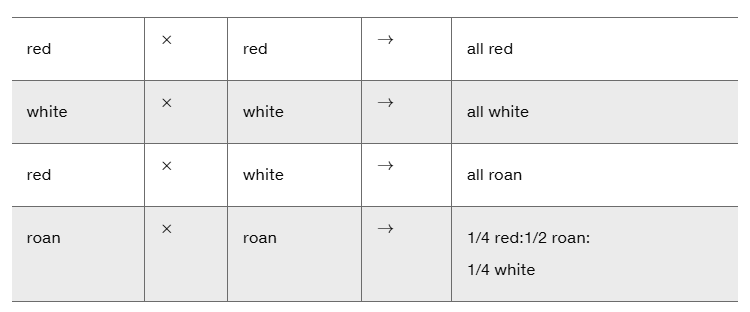
In shorthorn cattle, coat color may be red, white, or roan. Roan is an intermediate phenotype expressed as a mixture of red and white hairs. The following data were obtained from various crosses:

Does the roan phenotype illustrate a case of incomplete dominance or a case of codominance? Explain.

Verified step by step guidance
1
Step 1: Understand the phenotypes and their genetic relationships. In shorthorn cattle, the coat colors are red, white, and roan. Roan is described as a mixture of red and white hairs, suggesting an interaction between the red and white alleles.
Step 2: Analyze the results of the crosses. When red is crossed with red, all offspring are red; when white is crossed with white, all offspring are white. This indicates that red and white are true-breeding phenotypes.
Step 3: Look at the cross between red and white, which produces all roan offspring. This suggests that roan is the heterozygous phenotype, showing a distinct appearance from either homozygote.
Step 4: Examine the roan x roan cross, which produces offspring in the ratio 1/4 red : 1/2 roan : 1/4 white. This classic Mendelian 1:2:1 ratio is typical of incomplete dominance, where the heterozygote has an intermediate phenotype.
Step 5: Conclude that the roan phenotype illustrates incomplete dominance because the heterozygote (roan) shows an intermediate phenotype rather than both alleles being fully expressed separately, which would indicate codominance.

Key Concepts

Here are the essential concepts you must grasp in order to answer the question correctly.

Incomplete Dominance

Incomplete dominance occurs when the heterozygous phenotype is an intermediate blend of the two homozygous phenotypes. Neither allele is completely dominant, so the resulting trait is a mix, such as pink flowers from red and white parents. This differs from codominance where both traits appear distinctly.
Recommended video:
Guided course
04:37
Variations on Dominance

Codominance

Codominance is a genetic scenario where both alleles in a heterozygote are fully expressed, resulting in a phenotype that shows both traits simultaneously without blending. An example is roan cattle, where both red and white hairs are present together, not mixed into a new color.
Recommended video:
Guided course
04:37
Variations on Dominance

Genetic Crosses and Phenotypic Ratios

Analyzing offspring phenotypes from specific genetic crosses helps determine inheritance patterns. The given data show that crossing red and white cattle produces all roan offspring, and roan crosses yield a 1:2:1 ratio of red, roan, and white, indicating the nature of allele interaction.
Recommended video:
Guided course
10:20
Monohybrid Cross
Related Practice
Textbook Question

The discussion centers on extensions and modifications of Mendelian principles and ratios. In the process, we encountered many opportunities to consider how this information was acquired. On the basis of these discussions, what answers would you propose to the following fundamental questions?

For genes whose expression seems to be tied to the sex of individuals, how do we know whether a gene is X-linked in contrast to exhibiting sex-limited or sex-influenced inheritance?

505
views
Textbook Question

In shorthorn cattle, coat color may be red, white, or roan. Roan is an intermediate phenotype expressed as a mixture of red and white hairs. The following data were obtained from various crosses:

How is coat color inherited? What are the genotypes of parents and offspring for each cross?

1512
views
Textbook Question

With regard to the ABO blood types in humans, determine the genotype of the male parent and female parent shown here:

Male parent: Blood type B; mother type O

Female parent: Blood type A; father type B

Predict the blood types of the offspring that this couple may have and the expected proportion of each.

1325
views
Textbook Question

In foxes, two alleles of a single gene, P and p, may result in lethality (PP), platinum coat (Pp), or silver coat (pp). What ratio is obtained when platinum foxes are interbred? Is the P allele behaving dominantly or recessively in causing (a) lethality; (b) platinum coat color?

993
views
Textbook Question

Three gene pairs located on separate autosomes determine flower color and shape as well as plant height. The first pair exhibits incomplete dominance, where the color can be red, pink (the heterozygote), or white. The second pair leads to personate (dominant) or peloric (recessive) flower shape, while the third gene pair produces either the dominant tall trait or the recessive dwarf trait. Homozygous plants that are red, personate, and tall are crossed to those that are white, peloric, and dwarf. Determine the F₁ genotype(s) and phenotype(s). If the F₁ plants are interbred, what proportion of the offspring will exhibit the same phenotype as the F₁ plants?

827
views