Pearson+ LogoPearson+ Logo
Ch. 4 - Modification of Mendelian Ratios
Klug - Essentials of Genetics 10th Edition
Klug10th EditionEssentials of GeneticsISBN: 9780135588789Not the one you use?Change textbook
Chapter 4, Problem 30

The specification of the anterior–posterior axis in Drosophila embryos is initially controlled by various gene products that are synthesized and stored in the mature egg following oogenesis. Mutations in these genes result in abnormalities of the axis during embryogenesis, illustrating maternal effect. How do such mutations vary from those involved in organelle heredity that illustrate extranuclear inheritance? Devise a set of parallel crosses and expected outcomes involving mutant genes that contrast maternal effect and organelle heredity.

Verified step by step guidance
1
Step 1: Understand the difference between maternal effect genes and organelle heredity. Maternal effect genes are nuclear genes whose products (mRNA or proteins) are deposited by the mother into the egg and influence early embryonic development. Mutations in these genes affect the offspring's phenotype based on the mother's genotype, regardless of the offspring's own genotype. In contrast, organelle heredity involves genes located in extranuclear DNA (such as mitochondrial or chloroplast DNA), and inheritance is typically uniparental (often maternal), affecting traits passed through cytoplasmic organelles.
Step 2: Design a cross to illustrate maternal effect inheritance. For example, cross a homozygous mutant female (for a maternal effect gene) with a wild-type male. Since the mother is mutant, all offspring will show the mutant phenotype regardless of their own genotype. Then, cross a heterozygous or wild-type female with a mutant male; offspring will show the wild-type phenotype because the mother's genotype determines the phenotype.
Step 3: Design a parallel cross to illustrate organelle heredity. Cross a female carrying mutant mitochondria (or other organelle mutation) with a wild-type male. Because organelle DNA is inherited maternally, all offspring will inherit the mutant organelle phenotype. Conversely, crossing a wild-type female with a mutant male will produce offspring with wild-type phenotype, as organelles are not inherited from the father.
Step 4: Summarize expected outcomes in a table or list contrasting the two inheritance patterns: for maternal effect, offspring phenotype depends solely on the mother's nuclear genotype; for organelle heredity, offspring phenotype depends on the mother's cytoplasmic genotype (organelle DNA).
Step 5: Conclude by explaining how these crosses demonstrate the fundamental difference: maternal effect involves nuclear genes expressed in the mother affecting early development, while organelle heredity involves extranuclear genes inherited through cytoplasmic organelles, both leading to non-Mendelian inheritance patterns but via distinct mechanisms.

Key Concepts

Here are the essential concepts you must grasp in order to answer the question correctly.

Maternal Effect Genes

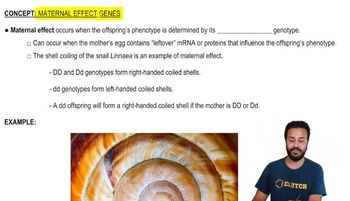
Maternal effect genes are those whose products, such as mRNAs or proteins, are deposited by the mother into the egg and influence early embryonic development. Mutations in these genes affect the offspring's phenotype regardless of the offspring's own genotype, because the phenotype depends on the mother's genotype. In Drosophila, these genes control axis specification, and defects lead to abnormal embryonic patterning.
Recommended video:
Guided course
03:38
Maternal Effect

Organelle Heredity and Extranuclear Inheritance

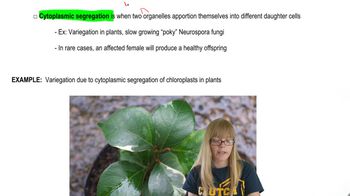
Organelle heredity refers to the transmission of genetic material found in organelles like mitochondria and chloroplasts, which have their own DNA separate from the nuclear genome. Extranuclear inheritance is typically uniparental (often maternal) and does not follow Mendelian inheritance patterns. Mutations in organelle genes affect traits inherited through the cytoplasm, differing from nuclear gene mutations.
Recommended video:
Guided course
05:13
Organelle Inheritance

Genetic Crosses to Distinguish Maternal Effect and Organelle Inheritance

Designing genetic crosses involves mating individuals with different genotypes to observe inheritance patterns. For maternal effect genes, the offspring phenotype depends on the mother's genotype, so reciprocal crosses show different outcomes. For organelle inheritance, traits are passed through the cytoplasm, so only offspring from mutant mothers show the phenotype, regardless of the father's genotype. Comparing these crosses highlights differences in inheritance mechanisms.
Recommended video:
Guided course
00:33
Maternal Effect