Pearson+ LogoPearson+ Logo
Ch. 5 - Sex Determination and Sex Chromosomes
Klug - Essentials of Genetics 10th Edition
Klug10th EditionEssentials of GeneticsISBN: 9780135588789Not the one you use?Change textbook
Chapter 5, Problem 24

The genes encoding the red- and green-color-detecting proteins of the human eye are located next to one another on the X chromosome and probably evolved from a common ancestral pigment gene. The two proteins demonstrate 76 percent homology in their amino acid sequences. A normal-visioned woman (with both genes present on each of her two X chromosomes) has a red-color-blind son who was shown to have one copy of the green-detecting gene and no copies of the red-detecting gene. Devise an explanation for these observations at the chromosomal level (involving meiosis).

Verified step by step guidance
1
Step 1: Understand the genetic context. The red- and green-color-detecting genes are located close together on the X chromosome, which means they are linked genes. Since males have only one X chromosome, they inherit their X chromosome from their mother and a Y chromosome from their father.
Step 2: Consider the mother's genotype. She has two X chromosomes, each carrying both the red- and green-detecting genes. This means she is likely heterozygous or homozygous for these genes, with normal vision because both genes are present on each X chromosome.
Step 3: Analyze meiosis in the mother. During meiosis, homologous chromosomes undergo recombination (crossing over), which can exchange segments between the red- and green-detecting gene loci. This can produce recombinant X chromosomes with altered gene combinations.
Step 4: Explain the son's genotype. The son inherited one X chromosome from his mother that contains the green-detecting gene but lacks the red-detecting gene. This suggests that a deletion or unequal crossing over occurred during meiosis, removing the red-detecting gene from that X chromosome.
Step 5: Summarize the chromosomal explanation. The son's red-color blindness results from inheriting an X chromosome missing the red-detecting gene due to a recombination event or deletion during maternal meiosis, while retaining the green-detecting gene. This explains the presence of one green gene and absence of the red gene on his single X chromosome.

Verified video answer for a similar problem:

This video solution was recommended by our tutors as helpful for the problem above.
Video duration:
1m
Was this helpful?

Key Concepts

Here are the essential concepts you must grasp in order to answer the question correctly.

X-linked Inheritance

X-linked inheritance refers to genes located on the X chromosome, which affect males and females differently due to their sex chromosome composition. Males have one X and one Y chromosome, so a single defective gene on the X chromosome can cause a trait or disorder, like red-green color blindness, to be expressed. Females have two X chromosomes, so they can be carriers without showing symptoms if only one X carries the mutation.
Recommended video:
Guided course
09:30
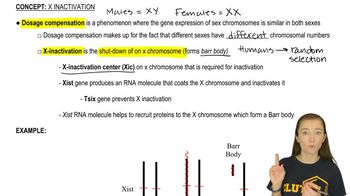
X-Inactivation

Meiosis and Chromosomal Segregation

Meiosis is the process of cell division that produces gametes with half the chromosome number. During meiosis, homologous chromosomes pair and can exchange segments through crossing over. This recombination can lead to deletions or duplications of genes, explaining how a son might inherit a missing red-detecting gene if a crossover event deleted it on the X chromosome inherited from his mother.
Recommended video:
Guided course
05:30
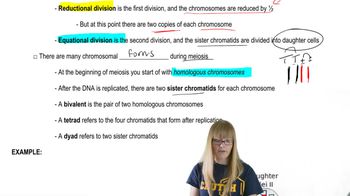
Meiosis Overview

Gene Duplication and Homology

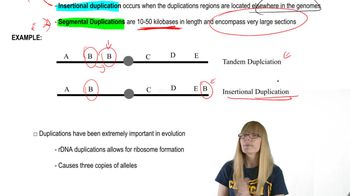
Gene duplication occurs when a gene is copied in the genome, often leading to gene families with similar sequences and functions. The red- and green-detecting pigment genes are paralogs, sharing 76% amino acid sequence homology, indicating they evolved from a common ancestral gene. Their close proximity on the X chromosome makes them susceptible to unequal crossing over, which can cause gene loss or rearrangement.
Recommended video:
Related Practice
Textbook Question

Cat breeders are aware that kittens expressing the X-linked calico coat pattern and tortoiseshell pattern are almost invariably females. Why are they certain of this?

491
views
Textbook Question

In mice, the Sry gene is located on the Y chromosome very close to one of the pseudoautosomal regions that pairs with the X chromosome during male meiosis. Given this information, propose a model to explain the generation of unusual males who have two X chromosomes (with an Sry-containing piece of the Y chromosome attached to one X chromosome).

1026
views
Textbook Question

In mice, the X-linked dominant mutation Testicular feminization (Tfm) eliminates the normal response to the testicular hormone testosterone during sexual differentiation. An XY mouse bearing the Tfm allele on the X chromosome develops testes, but no further male differentiation occurs—the external genitalia of such an animal are female. From this information, what might you conclude about the role of the Tfm gene product and the X and Y chromosomes in sex determination and sexual differentiation in mammals? Can you devise an experiment, assuming you can 'genetically engineer' the chromosomes of mice, to test and confirm your explanation?

748
views
Textbook Question

In chickens, a key gene involved in sex determination has recently been identified. Called DMRT1, it is located on the Z chromosome and is absent on the W chromosome. Like SRY in humans, it is male determining. Unlike SRY in humans, however, female chickens (ZW) have a single copy while males (ZZ) have two copies of the gene. Nevertheless, it is transcribed only in the developing testis. Working in the laboratory of Andrew Sinclair (a co-discoverer of the human SRY gene), Craig Smith and colleagues were able to 'knock down' expression of DMRT1 in ZZ embryos using RNA interference techniques. In such cases, the developing gonads look more like ovaries than testes. What conclusions can you draw about the role that the DMRT1 gene plays in chickens in contrast to the role the SRY gene plays in humans?

878
views