Pearson+ LogoPearson+ Logo
Ch. 6 - Chromosome Mutations: Variation in Number and Arrangement
Klug - Essentials of Genetics 10th Edition
Klug10th EditionEssentials of GeneticsISBN: 9780135588789Not the one you use?Change textbook
Chapter 6, Problem 18

In a cross between two varieties of corn,
gl1gl1Ws3Ws3 (egg parent) × Gl1Gl1ws3ws3 (pollen parent), a triploid offspring was produced with the genetic constitution Gl1Gl1gl1Ws3ws3ws3. From which parent, egg or pollen, did the 2n gamete originate? Is another explanation possible? Explain.

Verified step by step guidance
1
Step 1: Identify the genotypes of the parents and the offspring. The egg parent is gl\_1gl\_1 Ws\_3Ws\_3, and the pollen parent is Gl\_1Gl\_1 ws\_3ws\_3. The offspring is triploid with genotype Gl\_1Gl\_1gl\_1 Ws\_3ws\_3ws\_3.
Step 2: Understand that a triploid offspring (3 sets of chromosomes) results from the fusion of a normal haploid gamete (n) and an unreduced diploid gamete (2n). Determine which parent contributed the 2n gamete by comparing the alleles in the offspring to those in each parent.
Step 3: Analyze the Gl\_1 locus: the offspring has two Gl\_1 alleles and one gl\_1 allele. Since the pollen parent is Gl\_1Gl\_1 and the egg parent is gl\_1gl\_1, the two Gl\_1 alleles likely came from the pollen parent, and the single gl\_1 allele from the egg parent.
Step 4: Analyze the Ws\_3 locus: the offspring has one Ws\_3 allele and two ws\_3 alleles. The egg parent is Ws\_3Ws\_3 and the pollen parent is ws\_3ws\_3. The presence of two ws\_3 alleles suggests the pollen parent contributed a 2n gamete carrying two ws\_3 alleles.
Step 5: Conclude that the 2n gamete likely originated from the pollen parent because the offspring has two identical alleles from the pollen parent at both loci. Another explanation could be that the egg parent produced the 2n gamete, but this would not fit the allele distribution observed in the offspring.

Key Concepts

Here are the essential concepts you must grasp in order to answer the question correctly.

Triploid Offspring and 2n Gametes

Triploid organisms have three sets of chromosomes, often resulting from the fusion of a normal haploid (n) gamete with an unreduced diploid (2n) gamete. A 2n gamete contains the full diploid chromosome number due to errors in meiosis, such as nondisjunction. Identifying the parent that contributed the 2n gamete helps explain the genetic makeup of the triploid offspring.
Recommended video:
Guided course
21:21
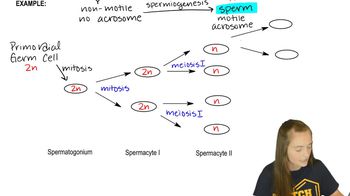
Gamete Development

Genetic Notation and Allelic Composition

Understanding the genetic notation (e.g., Gl1Gl1, ws3ws3) is crucial to track allele inheritance. Homozygous alleles indicate identical copies, while heterozygous alleles show variation. By comparing the offspring’s genotype to the parents’, one can deduce which parent contributed extra alleles, revealing the origin of the 2n gamete.
Recommended video:
Guided course
03:03
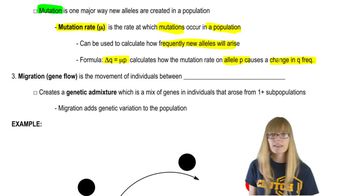
New Alleles and Migration

Mechanisms of 2n Gamete Formation and Alternative Explanations

2n gametes can form via meiotic errors like first or second division nondisjunction. Alternatively, polyspermy or fertilization anomalies might explain unusual ploidy. Considering these mechanisms allows evaluation of whether the 2n gamete came from the egg or pollen parent or if other explanations fit the observed genotype.
Recommended video:
Guided course
04:06
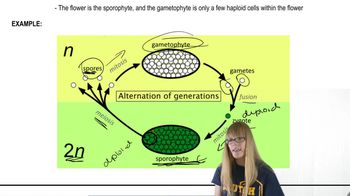
Formation of Plant Gametes
Related Practice
Textbook Question

Drosophila may be monosomic for chromosome 4, yet remain fertile. Contrast the F₁ and F₂ results of the following crosses involving the recessive chromosome 4 trait, bent bristles:

monosomic IV, normal bristles x diploid, bent bristles.

536
views
Textbook Question

Mendelian ratios are modified in crosses involving autotetraploids. Assume that one plant expresses the dominant trait green seeds and is homozygous (WWWW). This plant is crossed to one with white seeds that is also homozygous (wwww). If only one dominant allele is sufficient to produce green seeds, predict the F₁ and F₂ results of such a cross. Assume that synapsis between chromosome pairs is random during meiosis.

710
views
Textbook Question

Having correctly established the F₂ ratio in Problem 18, predict the F₂ ratio of a 'dihybrid' cross involving two independently assorting characteristics (e.g., P₁ = WWWWAAAA x wwwwaaaa).

640
views
Textbook Question

A couple planning their family are aware that through the past three generations on the husband's side a substantial number of stillbirths have occurred and several malformed babies were born who died early in childhood. The wife has studied genetics and urges her husband to visit a genetic counseling clinic, where a complete karyotype-banding analysis is performed. Although the tests show that he has a normal complement of 46 chromosomes, banding analysis reveals that one member of the chromosome 1 pair (in group A) contains an inversion covering 70 percent of its length. The homolog of chromosome 1 and all other chromosomes show the normal banding sequence.

How would you explain the high incidence of past stillbirths?

653
views
Textbook Question

A couple planning their family are aware that through the past three generations on the husband's side a substantial number of stillbirths have occurred and several malformed babies were born who died early in childhood. The wife has studied genetics and urges her husband to visit a genetic counseling clinic, where a complete karyotype-banding analysis is performed. Although the tests show that he has a normal complement of 46 chromosomes, banding analysis reveals that one member of the chromosome 1 pair (in group A) contains an inversion covering 70 percent of its length. The homolog of chromosome 1 and all other chromosomes show the normal banding sequence.

What can you predict about the probability of abnormality/normality of their future children?

430
views
Textbook Question

A couple planning their family are aware that through the past three generations on the husband's side a substantial number of stillbirths have occurred and several malformed babies were born who died early in childhood. The wife has studied genetics and urges her husband to visit a genetic counseling clinic, where a complete karyotype-banding analysis is performed. Although the tests show that he has a normal complement of 46 chromosomes, banding analysis reveals that one member of the chromosome 1 pair (in group A) contains an inversion covering 70 percent of its length. The homolog of chromosome 1 and all other chromosomes show the normal banding sequence.

Would you advise the woman that she will have to bring each pregnancy to term to determine whether the fetus is normal? If not, what else can you suggest?

449
views