
Pearson+ LogoPearson+ Logo
Ch. 6 - Chromosome Mutations: Variation in Number and Arrangement
Klug - Essentials of Genetics 10th Edition
Klug10th EditionEssentials of GeneticsISBN: 9780135588789Not the one you use?Change textbook
Chapter 6, Problem 24

In a human genetic study, a family with five phenotypically normal children was investigated. Two children were “homozygous” for a Robertsonian translocation between chromosomes 19 and 20 (they contained two identical copies of the fused chromosome). They have only 44 chromosomes but a complete genetic complement. Three of the children were “heterozygous” for the translocation and contained 45 chromosomes, with one translocated chromosome plus a normal copy of both chromosomes 19 and 20. Two other pregnancies resulted in stillbirths. It was later discovered that the parents were first cousins. Based on this information, determine the chromosome compositions of the parents. What led to the stillbirths? Why was the discovery that the parents were first cousins a key piece of information in understanding the genetics of this family?

Verified step by step guidance
1
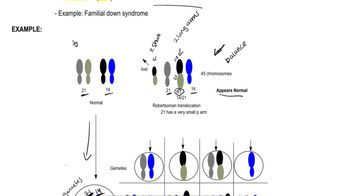
Step 1: Understand the nature of the Robertsonian translocation described. A Robertsonian translocation involves the fusion of two acrocentric chromosomes (here chromosomes 19 and 20) at their centromeres, resulting in a single chromosome that carries genetic material from both original chromosomes. Individuals with this translocation can have fewer chromosomes but still maintain a complete genetic complement if no essential genetic material is lost.
Step 2: Analyze the chromosome numbers and genotypes of the children. Two children are homozygous for the translocation, meaning they have two copies of the fused chromosome and no separate copies of chromosomes 19 and 20, resulting in 44 chromosomes total. Three children are heterozygous, having one fused chromosome plus one normal chromosome 19 and one normal chromosome 20, totaling 45 chromosomes. This suggests the parents each carry at least one copy of the translocation chromosome.
Step 3: Deduce the chromosome composition of the parents. Since homozygous children exist, both parents must carry the translocation chromosome. The parents are likely heterozygous carriers, each having one fused chromosome (translocation) and one normal chromosome 19 and one normal chromosome 20, resulting in 45 chromosomes. This genotype allows for the production of gametes that can combine to form homozygous, heterozygous, or unbalanced offspring.
Step 4: Explain the cause of the stillbirths. The stillbirths likely resulted from unbalanced chromosomal complements due to segregation errors during meiosis in the heterozygous parents. Some gametes may have lacked essential parts of chromosomes 19 or 20 or had duplications, leading to lethal genetic imbalances in the embryos.
Step 5: Discuss why the parents being first cousins is important. Consanguinity increases the chance that both parents carry the same rare genetic rearrangement, such as this Robertsonian translocation. This explains the presence of homozygous offspring, which is rare in the general population, and highlights the increased risk of genetic disorders or chromosomal abnormalities in offspring of related individuals.

Key Concepts

Here are the essential concepts you must grasp in order to answer the question correctly.

Robertsonian Translocation

A Robertsonian translocation is a chromosomal rearrangement where two acrocentric chromosomes fuse at their centromeres, forming a single chromosome. Individuals with this translocation have a reduced chromosome number but usually maintain a full genetic complement. This can lead to balanced carriers (heterozygous) or unbalanced gametes causing miscarriages or stillbirths.
Recommended video:
Guided course
09:31
Robertsonian Translocations

Homozygosity and Heterozygosity in Chromosomal Translocations

Homozygous individuals carry two identical copies of a translocated chromosome, resulting in a balanced genetic complement despite fewer chromosomes. Heterozygous carriers have one translocated chromosome and normal homologs, which can produce unbalanced gametes during meiosis, increasing the risk of miscarriages or stillbirths due to chromosomal imbalances.
Recommended video:
Guided course
12:42
Reciprocal Translocation

Consanguinity and Its Genetic Implications

Consanguinity refers to mating between close relatives, increasing the chance of inheriting identical alleles or chromosomal rearrangements from a common ancestor. In this case, it explains how both parents could carry the same rare Robertsonian translocation, leading to homozygous offspring and affecting the family's genetic outcomes.
Recommended video:
Guided course
03:45
Descriptive Genetics
Related Practice
Textbook Question

A boy with Klinefelter syndrome (47,XXY) is born to a mother who is phenotypically normal and a father who has the X-linked skin condition called anhidrotic ectodermal dysplasia. The mother's skin is completely normal with no signs of the skin abnormality. In contrast, her son has patches of normal skin and patches of abnormal skin.

Which parent contributed the abnormal gamete?

2301
views
Textbook Question

A boy with Klinefelter syndrome (47,XXY) is born to a mother who is phenotypically normal and a father who has the X-linked skin condition called anhidrotic ectodermal dysplasia. The mother's skin is completely normal with no signs of the skin abnormality. In contrast, her son has patches of normal skin and patches of abnormal skin.

Using the appropriate genetic terminology, describe the meiotic mistake that occurred. Be sure to indicate in which division the mistake occurred.

1525
views
Textbook Question

A boy with Klinefelter syndrome (47,XXY) is born to a mother who is phenotypically normal and a father who has the X-linked skin condition called anhidrotic ectodermal dysplasia. The mother's skin is completely normal with no signs of the skin abnormality. In contrast, her son has patches of normal skin and patches of abnormal skin.

Using the appropriate genetic terminology, explain the son's skin phenotype.

2491
views
Textbook Question

A 3-year-old child exhibited some early indication of Turner syndrome, which results from a 45,X chromosome composition. Karyotypic analysis demonstrated two cell types: 46,XX (normal) and 45,X. Propose a mechanism for the origin of this mosaicism.

880
views
Textbook Question

A normal female is discovered with 45 chromosomes, one of which exhibits a Robertsonian translocation containing most of chromosomes 15 and 21. Discuss the possible outcomes in her offspring when her husband contains a normal karyotype.

895
views
Textbook Question

In a cross in Drosophila, a female heterozygous for the autosomally linked genes a, b, c, d, and e (abcde/ +++++) was testcrossed with a male homozygous for all recessive alleles. Even though the distance between each of the loci was at least 3 map units, only four phenotypes were recovered, yielding the following data:

Why are many expected crossover phenotypes missing? Can any of these loci be mapped from the data given here? If so, determine map distances.

876
views