Pearson+ LogoPearson+ Logo
Ch. 6 - Chromosome Mutations: Variation in Number and Arrangement
Klug - Essentials of Genetics 10th Edition
Klug10th EditionEssentials of GeneticsISBN: 9780135588789Not the one you use?Change textbook
Chapter 6, Problem 11

Predict the genetic composition of gametes derived from tetrads of inversion heterozygotes where crossing over occurs within a pericentric inversion.

Verified step by step guidance
1
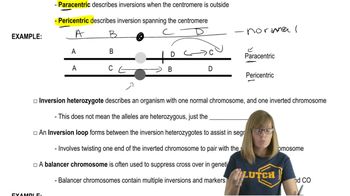
Understand the structure of a pericentric inversion: it involves a chromosome segment that includes the centromere, where a segment is flipped in orientation. In an inversion heterozygote, one chromosome has the normal sequence, and the homolog has the inverted segment.
Recognize that during meiosis, homologous chromosomes pair and form a tetrad. In inversion heterozygotes, the chromosomes form an inversion loop to align homologous regions properly.
Consider the effect of crossing over within the inversion loop: a single crossover inside a pericentric inversion produces recombinant chromatids with duplications and deletions, which are typically genetically unbalanced and often inviable.
Identify the types of gametes produced: (1) non-recombinant (parental) chromatids that are balanced and viable, and (2) recombinant chromatids resulting from crossing over within the inversion loop that carry duplications and deletions and are usually inviable.
Predict the genetic composition of gametes by noting that viable gametes will mostly be the non-recombinant types, while recombinant gametes from crossing over within the pericentric inversion will be genetically unbalanced and typically lost.

Key Concepts

Here are the essential concepts you must grasp in order to answer the question correctly.

Pericentric Inversion

A pericentric inversion is a chromosomal rearrangement that involves a segment including the centromere being flipped in orientation. This inversion changes the gene order and can affect recombination during meiosis, especially when heterozygous, leading to abnormal chromosomal structures in gametes if crossing over occurs within the inverted region.
Recommended video:

Crossing Over in Inversion Heterozygotes

Crossing over within the inverted segment of an inversion heterozygote can produce recombinant chromatids with duplications and deletions. In pericentric inversions, such crossovers often generate unbalanced gametes, which may be inviable or lead to genetic disorders, affecting the genetic composition of the resulting gametes.
Recommended video:

Tetrad Formation and Gamete Prediction

During meiosis, homologous chromosomes form tetrads allowing crossing over. In inversion heterozygotes, the tetrad loops to align homologous regions. Predicting gamete composition requires understanding how crossing over within the inversion loop affects chromatid segregation, resulting in a mix of normal, inverted, and recombinant chromatids with potential duplications or deletions.
Recommended video:
Guided course
04:06
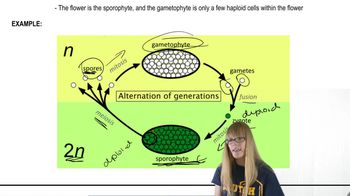
Formation of Plant Gametes
Related Practice
Textbook Question

Describe the origin of cultivated American cotton.

794
views
Textbook Question

Predict how the synaptic configurations of homologous pairs of chromosomes might appear when one member is normal and the other member has sustained a deletion or duplication.

613
views
Textbook Question

Inversions are said to 'suppress crossing over.' Is this terminology technically correct? If not, restate the description accurately.

682
views
Textbook Question

Human adult hemoglobin is a tetramer containing two alpha (α) and two beta (β) polypeptide chains. The α gene cluster on chromosome 16 and the β gene cluster on chromosome 11 share amino acid similarities such that 61 of the amino acids of the α-globin polypeptide (141 amino acids long) are shared in identical sequence with the β-globin polypeptide (146 amino acids long). How might one explain the existence of two polypeptides with partially shared function and structure on two different chromosomes?

567
views
Textbook Question

The primrose, Primula kewensis, has 36 chromosomes that are similar in appearance to the chromosomes in two related species, P. floribunda (2n=18) and P. verticillata (2n=18). How could P. kewensis arise from these species? How would you describe P. kewensis in genetic terms?

894
views
Textbook Question

Certain varieties of chrysanthemums contain 18, 36, 54, 72, and 90 chromosomes; all are multiples of a basic set of nine chromosomes. How would you describe these varieties genetically? What feature do the karyotypes of each variety share? A variety with 27 chromosomes has been discovered, but it is sterile. Why?

506
views