
Pearson+ LogoPearson+ Logo
Ch. 7 - Linkage and Chromosome Mapping in Eukaryotes
Klug - Essentials of Genetics 10th Edition
Klug10th EditionEssentials of GeneticsISBN: 9780135588789Not the one you use?Change textbook
Chapter 7, Problem 23

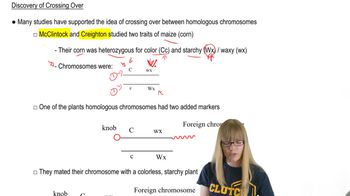
In Creighton and McClintock’s experiment demonstrating that crossing over involves physical exchange between chromosomes, explain the importance of the cytological markers (the translocated segment and the chromosome knob) in the experimental rationale.

Verified step by step guidance
1
Understand that Creighton and McClintock’s experiment aimed to demonstrate that genetic recombination (crossing over) corresponds to a physical exchange of chromosome segments during meiosis.
Recognize that cytological markers, such as the translocated segment and the chromosome knob, are visible structural features on chromosomes that can be identified under a microscope, allowing researchers to track physical changes in chromosome structure.
Note that the translocated segment is a piece of chromosome that has been moved to a different chromosome, and the chromosome knob is a distinct, easily identifiable bulge on a chromosome; these serve as physical landmarks.
Realize that by following these markers through meiosis and into the offspring, Creighton and McClintock could correlate the presence of genetic recombination (observed through genetic traits) with the physical exchange of these marked chromosome segments.
Conclude that the importance of these cytological markers lies in providing direct visual evidence that crossing over involves the actual breakage and rejoining of chromosome parts, linking genetic data with physical chromosome behavior.

Key Concepts

Here are the essential concepts you must grasp in order to answer the question correctly.

Crossing Over and Genetic Recombination

Crossing over is the process where homologous chromosomes exchange segments during meiosis, leading to genetic recombination. This physical exchange increases genetic diversity by producing new allele combinations in gametes, which is fundamental to inheritance and evolution.
Recommended video:
Guided course
05:19
Discovery of Crossing Over

Cytological Markers in Chromosome Identification

Cytological markers, such as visible chromosome knobs or translocated segments, are distinct physical features used to identify specific chromosome regions under a microscope. These markers allow researchers to track chromosome behavior and structural changes during meiosis.
Recommended video:
Guided course
07:11
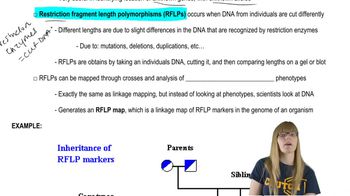
Mapping with Markers

Experimental Rationale in Creighton and McClintock’s Study

Creighton and McClintock used cytological markers to demonstrate that genetic recombination corresponds to a physical exchange of chromosome parts. By correlating the presence of markers with genetic traits, they provided direct evidence that crossing over involves actual chromosome segment swapping.
Recommended video:
Guided course
08:30
Genetics of Development