
Pearson+ LogoPearson+ Logo
Ch. 8 - Genetic Analysis and Mapping in Bacteria and Bacteriophages
Klug - Essentials of Genetics 10th Edition
Klug10th EditionEssentials of GeneticsISBN: 9780135588789Not the one you use?Change textbook
Chapter 8, Problem 12

In the plaque assay, what is the precise origin of a single plaque?

Verified step by step guidance
1
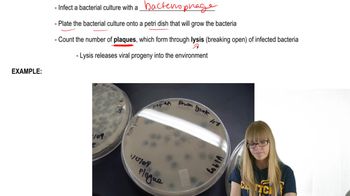
Understand that a plaque assay is a method used to quantify the number of virus particles capable of infecting cells in a sample by forming clear zones called plaques on a layer of host cells.
Recognize that each plaque originates from a single infectious virus particle, often referred to as a plaque-forming unit (PFU).
Know that when a single virus particle infects a host cell, it replicates and causes cell lysis, releasing progeny viruses that infect neighboring cells, leading to a localized area of cell destruction visible as a plaque.
Therefore, the precise origin of a single plaque is one infectious virus particle that initiated infection in a single host cell.
This concept is fundamental because counting plaques allows estimation of the number of infectious virus particles in the original sample.

Key Concepts

Here are the essential concepts you must grasp in order to answer the question correctly.

Plaque Assay Technique

The plaque assay is a method used to quantify viruses by infecting a layer of host cells and observing clear zones called plaques. Each plaque represents an area where the virus has lysed the host cells, allowing researchers to estimate viral concentration.
Recommended video:
Guided course
03:44
Plaques and Experiments

Origin of a Single Plaque

A single plaque originates from one infectious viral particle, or virion, that infects a host cell and initiates a localized infection. This infection spreads to neighboring cells, causing cell lysis and forming a visible plaque.
Recommended video:
Guided course
03:44
Plaques and Experiments

Host Cell Lysis and Viral Replication

After a virus infects a host cell, it replicates inside until the cell bursts (lysis), releasing new virions. These progeny infect adjacent cells, leading to a chain reaction that creates the clear zone observed as a plaque.
Recommended video:
Guided course
02:39
Bacteria and Viral Chromosome Structure