
Textbook Question
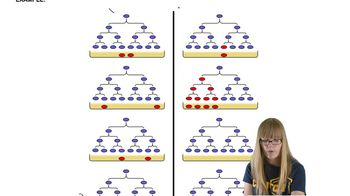
What did the Watson–Crick model suggest about the replication of DNA?
1226
views

 Verified step by step guidance
 09:52
09:52
 03:49
03:49 09:49
09:49What did the Watson–Crick model suggest about the replication of DNA?
One of the most common spontaneous lesions that occurs in DNA under physiological conditions is the hydrolysis of the amino group of cytosine, converting the cytosine to uracil. What would be the effect on DNA structure of a uracil group replacing cytosine?
A genetics student was asked to draw the chemical structure of an adenine- and thymine-containing dinucleotide derived from DNA. The answer is shown here:
The student made more than six major errors. One of them is circled, numbered 1, and explained. Find five others. Circle them, number them 2 through 6, and briefly explain each in the manner of the example given.
A primitive eukaryote was discovered that displayed a unique nucleic acid as its genetic material. Analysis provided the following information:
About 75 percent of the sugars are deoxyribose, while 25 percent are ribose.
Postulate a model for the structure of this molecule that is consistent with the foregoing observations.
A primitive eukaryote was discovered that displayed a unique nucleic acid as its genetic material. Analysis provided the following information:
Base-composition analysis reveals four bases in the following proportions: Adenine = 8%; Guanine = 37%; Xanthine = 37%; Hypoxanthine = 18%
A primitive eukaryote was discovered that displayed a unique nucleic acid as its genetic material. Analysis provided the following information:
The general X-ray diffraction pattern is similar to that of DNA, but with somewhat different dimensions and more irregularity.