Pearson+ LogoPearson+ Logo
Ch. 12 - DNA Organization in Chromosomes
Klug - Concepts of Genetics  12th Edition
Klug12th EditionConcepts of Genetics ISBN: 9780135564776Not the one you use?Change textbook
Chapter 12, Problem 19

Cancer can be defined as an abnormal proliferation of cells that defy the normal regulatory controls observed by normal cells. Recently, histone deacetylation therapies have been attempted in the treatment of certain cancers [reviewed by Delcuve et al. (2009)]. Specifically, the FDA has approved histone deacetylation (HDAC) inhibitors for the treatment of cutaneous T-cell lymphoma. Explain why histone acetylation might be associated with cancer and what the rationale is for the use of HDAC inhibitors in the treatment of certain forms of cancer.

Verified step by step guidance
1
Understand the role of histone acetylation in gene expression: Histone acetylation involves the addition of acetyl groups to histone proteins, which reduces the positive charge on histones and weakens their interaction with negatively charged DNA. This process makes the chromatin structure more open, allowing transcription factors and RNA polymerase to access DNA and promote gene expression.
Recognize the connection between histone acetylation and cancer: In cancer, abnormal histone acetylation patterns can lead to the overexpression of oncogenes (genes that promote cell proliferation) or the silencing of tumor suppressor genes (genes that inhibit cell proliferation). This imbalance can contribute to uncontrolled cell growth and cancer development.
Understand the mechanism of histone deacetylation: Histone deacetylation is the removal of acetyl groups from histones, leading to a more compact chromatin structure and reduced gene expression. Histone deacetylases (HDACs) are enzymes responsible for this process, and their dysregulation can also contribute to cancer by silencing tumor suppressor genes.
Explore the rationale for HDAC inhibitors in cancer therapy: HDAC inhibitors block the activity of histone deacetylases, preventing the removal of acetyl groups from histones. This can restore the expression of tumor suppressor genes and reduce the expression of oncogenes, thereby inhibiting cancer cell proliferation and promoting apoptosis (programmed cell death).
Consider the specific application to cutaneous T-cell lymphoma: The FDA-approved HDAC inhibitors for cutaneous T-cell lymphoma work by targeting the epigenetic dysregulation in these cancer cells. By modulating histone acetylation, these therapies aim to restore normal gene expression patterns and control the abnormal proliferation of T-cells.

Verified video answer for a similar problem:

This video solution was recommended by our tutors as helpful for the problem above.
Video duration:
2m
Was this helpful?

Key Concepts

Here are the essential concepts you must grasp in order to answer the question correctly.

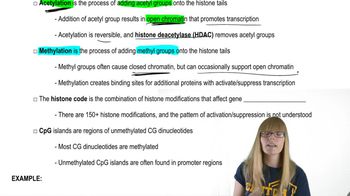
Histone Acetylation

Histone acetylation is a post-translational modification where acetyl groups are added to histone proteins, leading to a more relaxed chromatin structure. This modification enhances gene expression by allowing transcription factors easier access to DNA. In cancer, abnormal patterns of histone acetylation can result in the overexpression of oncogenes or the silencing of tumor suppressor genes, contributing to uncontrolled cell proliferation.
Recommended video:
Guided course
07:55
Histone Protein Modifications

Histone Deacetylases (HDACs)

Histone deacetylases (HDACs) are enzymes that remove acetyl groups from histones, leading to a more compact chromatin structure and reduced gene expression. In cancer, HDACs can be overactive, resulting in the repression of genes that normally inhibit cell growth and promote apoptosis. This dysregulation of HDAC activity is a key factor in the development and progression of various cancers.
Recommended video:
Guided course
07:55
Histone Protein Modifications

HDAC Inhibitors

HDAC inhibitors are a class of drugs that block the activity of histone deacetylases, thereby increasing histone acetylation and promoting a more open chromatin structure. This can reactivate silenced tumor suppressor genes and restore normal cell cycle regulation. The FDA-approved HDAC inhibitors for certain cancers, such as cutaneous T-cell lymphoma, aim to reverse the aberrant gene expression patterns associated with malignancies, offering a targeted therapeutic approach.
Related Practice
Textbook Question

Contrast the structure of SINE and LINE DNA sequences. Why are LINEs referred to as retrotransposons?

1069
views
Textbook Question

Variable number tandem repeats (VNTRs) are repeating DNA sequences of about 15–100 bp in length, found both within and between genes. Why are they commonly used in forensics?

1050
views
Textbook Question

It has been shown that infectious agents such as viruses often exert a dramatic effect on their host cell's genome architecture. In many cases, viruses induce methylation of host DNA sequences in order to enhance their infectivity. What specific host gene functions would you consider as strong candidates for such methylation by infecting viruses?

569
views
Textbook Question
In a study of Drosophila, two normally active genes, w⁺ (wild-type allele of the white-eye gene) and hsp26 (a heat-shock gene), were introduced (using a plasmid vector) into euchromatic and heterochromatic chromosomal regions, and the relative activity of each gene was assessed [Sun et al. (2002)]. An approximation of the resulting data is shown in the following table. Which characteristic or characteristics of heterochromatin are supported by the experimental data?Gene Activity (relative percentage) _Euchromatin Heterochromatinhsp26 100% 31%w⁺ 100% 8%
515
views
Textbook Question

While much remains to be learned about the role of nucleosomes and chromatin structure and function, recent research indicates that in vivo chemical modification of histones is associated with changes in gene activity. One study determined that acetylation of H3 and H4 is associated with 21.1 percent and 13.8 percent increases in yeast gene activity, respectively, and that histones associated with yeast heterochromatin are hypomethylated relative to the genome average [Bernstein et al. (2000)]. Speculate on the significance of these findings in terms of nucleosome–DNA interactions and gene activity.

799
views
Textbook Question

An article entitled 'Nucleosome Positioning at the Replication Fork' states: 'both the 'old' randomly segregated nucleosomes as well as the 'new' assembled histone octamers rapidly position themselves (within seconds) on the newly replicated DNA strands' [Lucchini et al. (2002)]. Given this statement, how would one compare the distribution of nucleosomes and DNA in newly replicated chromatin? How could one experimentally test the distribution of nucleosomes on newly replicated chromosomes?

576
views