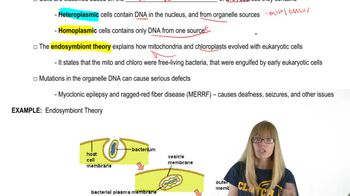
Provide a comprehensive definition of heterochromatin and list as many examples as you can.

How many base pairs are in a molecule of phage T2 DNA 52-µm long?
Verified step by step guidance
Verified video answer for a similar problem:
Key Concepts
DNA Structure and Base Pairing
DNA Length Measurement and Conversion
Phage T2 DNA Characteristics
Mammals contain a diploid genome consisting of at least 10⁹ bp. If this amount of DNA is present as chromatin fibers, where each group of 200 bp of DNA is combined with 9 histones into a nucleosome and each group of 6 nucleosomes is combined into a solenoid, achieving a final packing ratio of 50, determine:
(a) the total number of nucleosomes in all fibers,
(b) the total number of histone molecules combined with DNA in the diploid genome, and
(c) the combined length of all fibers.
Assume that a viral DNA molecule is a 50-µm-long circular strand with a uniform 20-Å diameter. If this molecule is contained in a viral head that is a 0.08-µm-diameter sphere, will the DNA molecule fit into the viral head, assuming complete flexibility of the molecule? Justify your answer mathematically.
Examples of histone modifications are acetylation (by histone acetyltransferase, or HAT), which is often linked to gene activation, and deacetylation (by histone deacetylases, or HDACs), which often leads to gene silencing typical of heterochromatin. Such heterochromatinization is initiated from a nucleation site and spreads bidirectionally until encountering boundaries that delimit the silenced areas. In the brief discussion of position effect, where repositioning of the w⁺ allele in Drosophila by translocation or inversion near heterochromatin produces intermittent w⁺ activity. In the heterozygous state (w⁺/w) a variegated eye is produced, with white and red patches. How might one explain position-effect variegation in terms of histone acetylation and/or deacetylation?
Contrast the structure of SINE and LINE DNA sequences. Why are LINEs referred to as retrotransposons?
Variable number tandem repeats (VNTRs) are repeating DNA sequences of about 15–100 bp in length, found both within and between genes. Why are they commonly used in forensics?
