Pearson+ LogoPearson+ Logo
Ch. 12 - DNA Organization in Chromosomes
Klug - Concepts of Genetics  12th Edition
Klug12th EditionConcepts of Genetics ISBN: 9780135564776Not the one you use?Change textbook
Chapter 12, Problem 1b

What is the experimental basis for concluding that puffs in polytene chromosomes and loops in lampbrush chromosomes are areas of intense transcription of RNA?

Verified step by step guidance
1
Understand that both polytene chromosome puffs and lampbrush chromosome loops are visibly distinct regions where the chromatin is less condensed, suggesting active processes occurring there.
Recognize that experimental techniques such as autoradiography have been used, where cells are incubated with radioactive RNA precursors (like tritiated uridine), allowing incorporation into newly synthesized RNA.
Note that after incubation, the chromosomes are fixed and exposed to photographic emulsion; the radioactive decay exposes the emulsion, revealing silver grains that indicate sites of RNA synthesis.
Observe that these silver grains are concentrated specifically over the puffs in polytene chromosomes and loops in lampbrush chromosomes, demonstrating that these regions are sites of active transcription.
Correlate these findings with biochemical assays showing increased RNA polymerase activity and the presence of nascent RNA transcripts in these regions, confirming that puffs and loops correspond to intense RNA transcription.

Verified video answer for a similar problem:

This video solution was recommended by our tutors as helpful for the problem above.
Video duration:
2m
Was this helpful?

Key Concepts

Here are the essential concepts you must grasp in order to answer the question correctly.

Polytene Chromosome Puffs

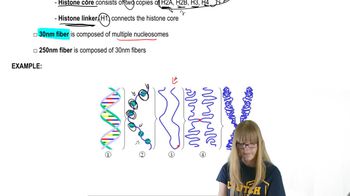
Polytene chromosomes are oversized chromosomes with many DNA strands aligned, found in certain cells like Drosophila salivary glands. Puffs are visibly swollen regions indicating active gene expression, where chromatin decondenses to allow RNA polymerase access for transcription.
Recommended video:
Guided course
07:10
Chromosome Structure

Lampbrush Chromosome Loops

Lampbrush chromosomes, seen in amphibian oocytes, have extended lateral loops representing regions of active transcription. These loops contain nascent RNA transcripts and associated proteins, demonstrating sites where genes are being actively transcribed.
Recommended video:
Guided course
07:10
Chromosome Structure

Experimental Evidence of Transcription Activity

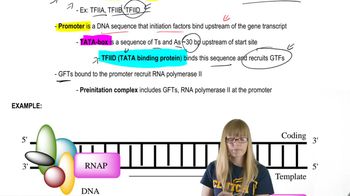
Techniques like autoradiography using radioactive RNA precursors and electron microscopy have shown that puffs and loops incorporate labeled nucleotides, confirming RNA synthesis. Additionally, the presence of RNA polymerase and nascent RNA in these regions supports their role as transcriptionally active sites.
Recommended video:
Guided course
09:16
Eukaryotic Transcription