Pearson+ LogoPearson+ Logo
Ch. 10 - Eukaryotic Chromosome Abnormalities and Molecular Organization
Sanders - Genetic Analysis: An Integrated Approach 3rd Edition
Sanders3rd EditionGenetic Analysis: An Integrated ApproachISBN: 9780135564172Not the one you use?Change textbook
Chapter 10, Problem 13d

An animal heterozygous for a reciprocal balanced translocation has the following chromosomes:
      MN • OPQRST
      MN • OPQRjkl
      cdef • ghijkl
      cdef • ghiST
Identify the gametes produced by adjacent-2 segregation. Which if any of these gametes are viable?

Verified step by step guidance
1
Understand the problem: The animal is heterozygous for a reciprocal balanced translocation, meaning two non-homologous chromosomes have exchanged segments. The goal is to identify the gametes produced by adjacent-2 segregation and determine their viability.
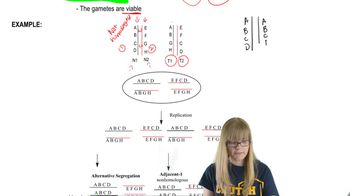
Recall the concept of adjacent-2 segregation: This type of segregation occurs during meiosis when homologous centromeres (from the same chromosome pair) move to the same pole, leading to gametes that contain both translocated and non-translocated chromosomes from the same set.
Analyze the chromosome pairs: The given chromosomes are MN • OPQRST, MN • OPQRjkl, cdef • ghijkl, and cdef • ghiST. Adjacent-2 segregation will result in gametes that combine one chromosome from each homologous pair, but centromeres from the same pair move together.
Determine the gametes: By pairing chromosomes based on adjacent-2 segregation, the gametes will be: (1) MN • OPQRST and cdef • ghijkl, (2) MN • OPQRjkl and cdef • ghiST. These combinations result in unbalanced gametes because they contain duplications and deletions of genetic material.
Assess viability: Gametes with duplications and deletions are typically inviable because they disrupt the balance of genetic material necessary for normal development. Therefore, none of the gametes produced by adjacent-2 segregation are likely to be viable.

Verified video answer for a similar problem:

This video solution was recommended by our tutors as helpful for the problem above.
Video duration:
1m
Was this helpful?

Key Concepts

Here are the essential concepts you must grasp in order to answer the question correctly.

Reciprocal Balanced Translocation

A reciprocal balanced translocation occurs when two non-homologous chromosomes exchange segments without any loss of genetic material. This results in a rearrangement of genes but maintains the overall genetic balance. In heterozygous individuals, one chromosome carries the normal gene arrangement while the other has the rearranged segments, which can affect gamete formation and viability.
Recommended video:
Guided course
12:42
Reciprocal Translocation

Adjacent-2 Segregation

Adjacent-2 segregation is a type of chromosomal segregation that occurs during meiosis in individuals with translocations. In this process, two homologous chromosomes with translocations segregate together, leading to gametes that contain both segments from one chromosome and none from the other. This can result in gametes with unbalanced genetic content, often leading to non-viable offspring.
Recommended video:
Guided course
12:42
Reciprocal Translocation

Gamete Viability

Gamete viability refers to the ability of gametes to develop into a viable organism after fertilization. In the context of adjacent-2 segregation, the gametes produced may have an unbalanced set of chromosomes, which typically results in non-viable zygotes. Understanding which gametes are viable is crucial for predicting the potential outcomes of fertilization in individuals with chromosomal abnormalities.
Recommended video:
Guided course
21:21
Gamete Development
Related Practice
Textbook Question

An animal heterozygous for a reciprocal balanced translocation has the following chromosomes:

      MN • OPQRST

      MN • OPQRjkl

      cdef • ghijkl

      cdef • ghiST

Diagram the pairing of these chromosomes in prophase I.

450
views
Textbook Question

An animal heterozygous for a reciprocal balanced translocation has the following chromosomes:

      MN • OPQRST

      MN • OPQRjkl

      cdef • ghijkl

      cdef • ghiST

Identify the gametes produced by alternate segregation. Which, if any, of these gametes are viable?

518
views
Textbook Question

An animal heterozygous for a reciprocal balanced translocation has the following chromosomes:

      MN • OPQRST

      MN • OPQRjkl

      cdef • ghijkl

      cdef • ghiST

Identify the gametes produced by adjacent-1 segregation. Which, if any, of these gametes are viable?

497
views
Textbook Question

An animal heterozygous for a reciprocal balanced translocation has the following chromosomes:

MN • OPQRST           

MN • OPQRjkl           

cdef • ghijkl           

cdef • ghiST

Among the three segregation patterns, which is least likely to occur? Why?

415
views
Textbook Question

Dr. Ara B. Dopsis has an idea he thinks will be a boon to agriculture. He wants to create the 'pomato,' a hybrid between a tomato (Lycopersicon esculentum) that has 12 chromosomes and a potato (Solanum tuberosum) that has 48 chromosomes. Dr. Dopsis is hoping his new pomato will have tuber growth like a potato and the fruit production of a tomato. He joins a haploid gamete from each species to form a hybrid and then induces doubling of chromosome number. How many chromosomes will the hybrid have before chromosome doubling?

425
views
Textbook Question

Dr. Ara B. Dopsis has an idea he thinks will be a boon to agriculture. He wants to create the 'pomato,' a hybrid between a tomato (Lycopersicon esculentum) that has 12 chromosomes and a potato (Solanum tuberosum) that has 48 chromosomes. Dr. Dopsis is hoping his new pomato will have tuber growth like a potato and the fruit production of a tomato. He joins a haploid gamete from each species to form a hybrid and then induces doubling of chromosome number. Will this hybrid be infertile?

379
views