Pearson+ LogoPearson+ Logo
Ch. 10 - Eukaryotic Chromosome Abnormalities and Molecular Organization
Sanders - Genetic Analysis: An Integrated Approach 3rd Edition
Sanders3rd EditionGenetic Analysis: An Integrated ApproachISBN: 9780135564172Not the one you use?Change textbook
Chapter 10, Problem 8a

If the haploid number for a plant species is 4, how many chromosomes are found in a member of the species that has one of the following characteristics? Explain your reasoning in each case.
Diploidy

Verified step by step guidance
1
Understand the concept of haploid number: The haploid number (n) represents the number of chromosomes in a single set of the organism's genome. For this plant species, the haploid number is given as 4 (n = 4).
Define diploidy: Diploidy refers to an organism having two complete sets of chromosomes, one set inherited from each parent. This means the total number of chromosomes in a diploid organism is 2n.
Apply the formula for diploidy: To calculate the total number of chromosomes in a diploid organism, use the formula: 2×n. Substitute the haploid number (n = 4) into the formula.
Perform the multiplication: Multiply 2 by the haploid number (4) to determine the total number of chromosomes in a diploid organism. This step provides the chromosome count for diploidy.
Explain the reasoning: Since diploidy involves two sets of chromosomes, the chromosome count is double the haploid number. This ensures the organism has a complete set of genetic material from both parents.

Verified video answer for a similar problem:

This video solution was recommended by our tutors as helpful for the problem above.
Video duration:
2m
Was this helpful?

Key Concepts

Here are the essential concepts you must grasp in order to answer the question correctly.

Haploid and Diploid

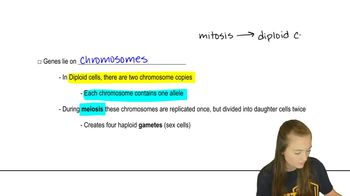
Haploid refers to a cell or organism that has a single set of chromosomes, denoted as 'n'. In contrast, diploid cells contain two sets of chromosomes, represented as '2n'. For the plant species in question, with a haploid number of 4, the diploid number would be 8, as diploidy means having two complete sets of chromosomes.
Recommended video:
Guided course
27:36
Diploid Genetics

Chromosome Number

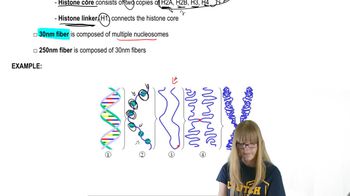
The chromosome number is the total count of chromosomes in a cell. In diploid organisms, this number is double that of haploid organisms. Understanding the relationship between haploid and diploid states is crucial for determining the chromosome count in various life stages of an organism, such as gametes and somatic cells.
Recommended video:
Guided course
07:10
Chromosome Structure

Plant Reproduction

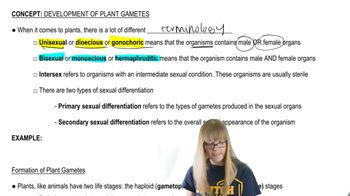
Plants typically reproduce through a life cycle that alternates between haploid (gametophyte) and diploid (sporophyte) stages. In this context, knowing that the diploid stage has twice the number of chromosomes as the haploid stage helps in understanding how genetic information is passed on and how traits are expressed in the plant species.
Recommended video:
Guided course
02:56
Plant Gamete Terminology