Ch. 14 - Analysis of Gene Function via Forward Genetics and Reverse Genetics
Sanders - Genetic Analysis: An Integrated Approach 3rd Edition
Sanders3rd EditionGenetic Analysis: An Integrated ApproachISBN: 9780135564172Not the one you use?Change textbook
Chapter 14, Problem C.2c

A tumor is a growing mass of abnormal cells. What must happen for a benign tumor to become malignant?

Verified step by step guidance
1
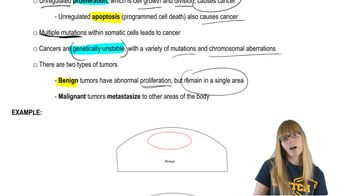
Understand the difference between benign and malignant tumors: benign tumors are non-cancerous growths that do not invade nearby tissues or spread to other parts of the body, while malignant tumors are cancerous and have the ability to invade and metastasize.
Recognize that for a benign tumor to become malignant, genetic changes must occur in the tumor cells that enable them to grow uncontrollably and invade surrounding tissues.
Identify that these genetic changes often involve mutations in oncogenes (genes that promote cell growth) and tumor suppressor genes (genes that inhibit cell growth), leading to loss of normal growth regulation.
Consider that additional changes may include the ability of tumor cells to evade apoptosis (programmed cell death), stimulate angiogenesis (formation of new blood vessels), and acquire the capacity to metastasize.
Summarize that the transition from benign to malignant involves a series of genetic and cellular alterations that transform the tumor cells into invasive and potentially metastatic cancer cells.

Verified video answer for a similar problem:

This video solution was recommended by our tutors as helpful for the problem above.
Video duration:
3m
Was this helpful?

Key Concepts

Here are the essential concepts you must grasp in order to answer the question correctly.

Benign vs. Malignant Tumors

Benign tumors are non-cancerous growths that do not invade nearby tissues or spread to other parts of the body. Malignant tumors are cancerous, capable of invading surrounding tissues and metastasizing to distant sites, making them more dangerous and harder to treat.
Recommended video:
Guided course
09:46
Cancer Characteristics

Genetic Mutations and Cellular Transformation

For a benign tumor to become malignant, cells must acquire genetic mutations that disrupt normal growth controls. These mutations often affect oncogenes and tumor suppressor genes, leading to uncontrolled cell division, resistance to cell death, and increased potential for invasion.
Recommended video:
Guided course
05:48
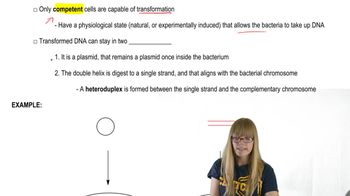
Transformation

Metastasis and Invasion Mechanisms

Malignant tumors gain the ability to invade surrounding tissues and spread through the bloodstream or lymphatic system. This involves changes in cell adhesion, increased motility, and secretion of enzymes that degrade extracellular matrix, enabling cancer cells to migrate and establish secondary tumors.
Recommended video:
Related Practice
Textbook Question

Identify the normal functions of the following genes whose mutations are associated with the development of cancer.

APC(familial adenomatous polyposis)

512
views
Textbook Question

You conduct a study in which the transcriptional fusion of regulatory sequences of a particular gene with a reporter gene results in relatively uniform expression of the reporter gene in all cells of an organism. A translational fusion with the same gene shows reporter gene expression only in the nucleus of a specific cell type. Discuss some biological causes for the difference in expression patterns of the two transgenes.

512
views
Textbook Question

A tumor is a growing mass of abnormal cells. Give an example from this chapter of a benign tumor that becomes a malignant tumor.

442
views
Textbook Question

A tumor is a growing mass of abnormal cells. Describe the difference between a benign tumor and a malignant tumor.

636
views
Textbook Question

Discuss the similarities and differences between forward and reverse genetic approaches, and when you would choose to utilize each of the approaches.

779
views
Textbook Question

Go to the National Institute for Child Health and Human Development (http://www.nichd.nih.gov), locate the search box at the top right corner of the homepage, and enter 'RUSP' to search for information on the Recommended Uniform Screening Panel. From the options that appear, select 'Brief History of Newborn Screening' and locate the discussion listing the criteria for adding a disease to the RUSP list. What are the criteria for listing a disease on the RUSP list?

424
views