
Textbook Question
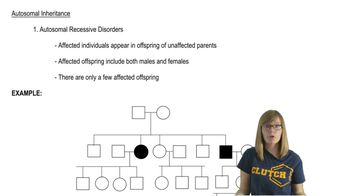
A woman expressing a dominant phenotype is heterozygous (Dd) for the gene.
What is the probability that the dominant allele carried by the woman will be inherited by a grandchild?
525
views

 Verified step by step guidance
 09:08
09:08
 04:58
04:58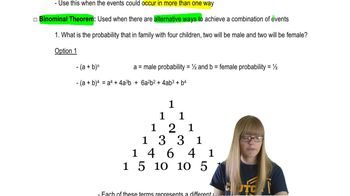 07:41
07:41A woman expressing a dominant phenotype is heterozygous (Dd) for the gene.
What is the probability that the dominant allele carried by the woman will be inherited by a grandchild?
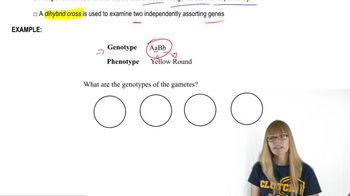
A male and a female are each heterozygous for both cystic fibrosis (CF) and phenylketonuria (PKU). Both conditions are autosomal recessive, and they assort independently.
What proportion of the children of this couple will have neither condition?
A woman expressing a dominant phenotype is heterozygous (Dd) for the gene.
What is the probability that two grandchildren of the woman who are first cousins to one another will each inherit the dominant allele?
A male and a female are each heterozygous for both cystic fibrosis (CF) and phenylketonuria (PKU). Both conditions are autosomal recessive, and they assort independently.
What proportion of the children will have either PKU or CF but not both?
During your work as a laboratory assistant in the research facilities of Dr. O. Sophila, a world-famous geneticist, you come across an unusual bottle of fruit flies. All the flies in the bottle appear normal when they are in an incubator set at 22°C. When they are moved to a 30°C incubator, however, a few of the flies slowly become paralyzed; and after about 20 to 30 minutes, they are unable to move. Returning the flies to 22°C restores their ability to move after about 30 to 45 minutes.
With Dr. Sophila's encouragement, you set up 10 individual crosses between single male and female flies that exhibit the unusual behavior. Among 812 progeny, 598 exhibit the unusual behavior and 214 do not. When you leave one of the test bottles in the 30°C incubator too long, you discover that more than 2 hours at high temperature kills the paralyzed flies. When you tell this to Dr. Sophila, he says, 'Aha! I know how to explain this condition.' What is his explanation?
Dr. Ara B. Dopsis and Dr. C. Ellie Gans are performing genetic crosses on daisy plants. They self-fertilize a blue-flowered daisy and grow 100 progeny plants that consist of 55 blue-flowered plants, 22 purple-flowered plants, and 23 white-flowered plants. Dr. Dopsis believes this is the result of segregation of two alleles at one locus and that the progeny ratio is 1:2:1. Dr. Gans thinks the progeny phenotypes are the result of two epistatic genes and that the ratio is 9:3:4.
The two scientists ask you to resolve their conflict by performing chi-square analysis on the data for both proposed genetic mechanisms. For each proposed mechanism, fill in the values requested on the form the researchers have provided for your analysis.
Using any of the 100 progeny plants, propose a cross that will verify the conclusion you proposed in part (c). Plants may be self-fertilized, or one plant can be crossed to another. What result will be consistent with the 1:2:1 hypothesis? What result will be consistent with the 9:3:4 hypothesis?