
Textbook Question
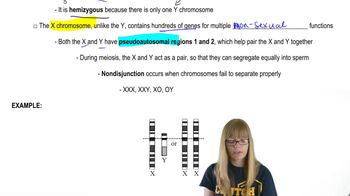
A wild-type Drosophila male and female are crossed, producing 324 female progeny and 161 male progeny. All their progeny are wild type.
Propose a genetic hypothesis to explain these data.
447
views

 Verified step by step guidance
 07:56
07:56
 03:13
03:13 10:48
10:48A wild-type Drosophila male and female are crossed, producing 324 female progeny and 161 male progeny. All their progeny are wild type.
Propose a genetic hypothesis to explain these data.
In an 1889 book titled Natural Inheritance (Macmillan, New York), Francis Galton, who investigated the inheritance of measurable (quantitative) traits, formulated a law of 'ancestral inheritance.' The law stated that individuals inherit approximately one-half of their genetic traits from each parent, about one-quarter of the traits from each grandparent, one-eighth from each great grandparent, and so on. In light of the chromosome theory of heredity, argue either in favor of Galton's law or against it.
In Drosophila, the X-linked echinus eye phenotype disrupts formation of facets and is recessive to wild-type eye. Autosomal recessive traits vestigial wing and ebony body assort independently of one another. Examine the progeny from the three crosses shown below, and identify the genotype of parents in each cross.
Drosophila has a diploid chromosome number of 2n = 8, which includes one pair of sex chromosomes (XX in females and XY in males) and three pairs of autosomes. Consider a Drosophila male that has a copy of the A₁ allele on its X chromosome (the Y chromosome is the homolog) and is heterozygous for alleles B₁ and B₂, C₁ and C₂, and D₁ and D₂ of genes that are each on a different autosomal pair. In the diagrams requested below, indicate the alleles carried on each chromosome and sister chromatid. Assume that no crossover occurs between homologous chromosomes.
What is the genotype of cells produced by mitotic division in this male?
Drosophila has a diploid chromosome number of 2n = 8, which includes one pair of sex chromosomes (XX in females and XY in males) and three pairs of autosomes. Consider a Drosophila male that has a copy of the A₁ allele on its X chromosome (the Y chromosome is the homolog) and is heterozygous for alleles B₁ and B₂, C₁ and C₂, and D₁ and D₂ of genes that are each on a different autosomal pair. In the diagrams requested below, indicate the alleles carried on each chromosome and sister chromatid. Assume that no crossover occurs between homologous chromosomes.
Diagram any correct alignment of chromosomes at mitotic metaphase.
Drosophila has a diploid chromosome number of 2n = 8, which includes one pair of sex chromosomes (XX in females and XY in males) and three pairs of autosomes. Consider a Drosophila male that has a copy of the A₁ allele on its X chromosome (the Y chromosome is the homolog) and is heterozygous for alleles B₁ and B₂, C₁ and C₂, and D₁ and D₂ of genes that are each on a different autosomal pair. In the diagrams requested below, indicate the alleles carried on each chromosome and sister chromatid. Assume that no crossover occurs between homologous chromosomes.
Diagram any correct alignment of chromosomes at metaphase I of meiosis.