Pearson+ LogoPearson+ Logo
Ch. 3 - Cell Division and Chromosome Heredity
Sanders - Genetic Analysis: An Integrated Approach 3rd Edition
Sanders3rd EditionGenetic Analysis: An Integrated ApproachISBN: 9780135564172Not the one you use?Change textbook
Chapter 3, Problem 32n

From a piece of blank paper, cut out three sets of four cigar-shaped structures (a total of 12 structures). These will represent chromatids. Be sure each member of a set of four chromatids has the same length and girth. In set one, label two chromatids 'A' and two chromatids 'a.' Cut each of these chromatids about halfway across near their midpoint and slide the two 'A' chromatids together at the cuts to form a single set of attached sister chromatids. Do the same for the 'a' chromatids. In the second set of four chromatids, label two 'B' and two 'b.' Cut and slide these together as you did for the first set, joining the 'B' chromatids together and the 'b' chromatids together. Repeat this process for the third set of chromatids, labeling them as 'D' and 'd.' You now have models for three pairs of homologous chromosomes, for a total of six chromosomes. Combining your work in steps (f) through (m), provide a written explanation of the connection between meiotic cell division and Mendel's law of independent assortment.

Verified step by step guidance
1
Step 1: Begin by understanding the physical representation of homologous chromosomes. Each pair of chromatids (e.g., 'A' and 'a') represents homologous chromosomes, which are similar in structure but may carry different alleles for a given gene.
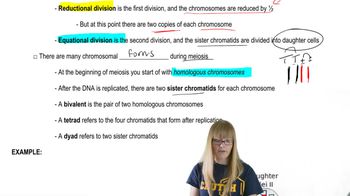
Step 2: Recall that during meiosis, homologous chromosomes are separated into different gametes. This separation occurs during Anaphase I, where homologous pairs are pulled apart, ensuring that each gamete receives only one chromosome from each pair.
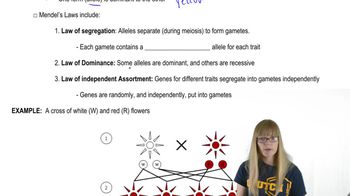
Step 3: Mendel's law of independent assortment states that alleles of different genes assort independently of one another during gamete formation. This is explained by the random alignment of homologous chromosome pairs during Metaphase I of meiosis. For example, the 'A/a' pair and 'B/b' pair align independently, leading to various combinations of alleles in the gametes.
Step 4: The physical model you created demonstrates this concept. By labeling and pairing chromatids ('A'/'a', 'B'/'b', 'D'/'d'), you can visualize how different combinations of alleles are possible depending on how the homologous chromosomes align and separate during meiosis.
Step 5: Finally, connect this process to genetic variation. The independent assortment of homologous chromosomes during meiosis contributes to genetic diversity in offspring, as it ensures that each gamete contains a unique combination of alleles from the parent organism.

Verified video answer for a similar problem:

This video solution was recommended by our tutors as helpful for the problem above.
Video duration:
3m
Was this helpful?

Key Concepts

Here are the essential concepts you must grasp in order to answer the question correctly.

Meiosis

Meiosis is a specialized type of cell division that reduces the chromosome number by half, resulting in four genetically diverse gametes. It consists of two sequential divisions: meiosis I, where homologous chromosomes are separated, and meiosis II, where sister chromatids are separated. This process is crucial for sexual reproduction, ensuring genetic diversity through recombination and independent assortment.
Recommended video:
Guided course
05:30
Meiosis Overview

Homologous Chromosomes

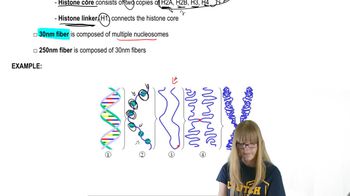
Homologous chromosomes are pairs of chromosomes, one inherited from each parent, that have the same genes at the same loci but may carry different alleles. During meiosis, these chromosomes pair up and can exchange genetic material through a process called crossing over. This pairing and subsequent separation during meiosis I are essential for the proper distribution of genetic information to gametes.
Recommended video:
Guided course
07:10
Chromosome Structure

Mendel's Law of Independent Assortment

Mendel's Law of Independent Assortment states that the alleles for different genes segregate independently of one another during gamete formation. This principle is illustrated during meiosis when homologous chromosomes align randomly at the metaphase plate, leading to various combinations of alleles in the resulting gametes. This law is fundamental to understanding genetic variation and inheritance patterns in offspring.
Recommended video:
Guided course
05:48
Mendel's Laws
Related Practice
Textbook Question

From a piece of blank paper, cut out three sets of four cigar-shaped structures (a total of 12 structures). These will represent chromatids. Be sure each member of a set of four chromatids has the same length and girth. In set one, label two chromatids 'A' and two chromatids 'a.' Cut each of these chromatids about halfway across near their midpoint and slide the two 'A' chromatids together at the cuts to form a single set of attached sister chromatids. Do the same for the 'a' chromatids. In the second set of four chromatids, label two 'B' and two 'b.' Cut and slide these together as you did for the first set, joining the 'B' chromatids together and the 'b' chromatids together. Repeat this process for the third set of chromatids, labeling them as 'D' and 'd.' You now have models for three pairs of homologous chromosomes, for a total of six chromosomes. Separate the chromosomes as though anaphase II and telophase II have taken place.

459
views
Textbook Question

From a piece of blank paper, cut out three sets of four cigar-shaped structures (a total of 12 structures). These will represent chromatids. Be sure each member of a set of four chromatids has the same length and girth. In set one, label two chromatids 'A' and two chromatids 'a.' Cut each of these chromatids about halfway across near their midpoint and slide the two 'A' chromatids together at the cuts to form a single set of attached sister chromatids. Do the same for the 'a' chromatids. In the second set of four chromatids, label two 'B' and two 'b.' Cut and slide these together as you did for the first set, joining the 'B' chromatids together and the 'b' chromatids together. Repeat this process for the third set of chromatids, labeling them as 'D' and 'd.' You now have models for three pairs of homologous chromosomes, for a total of six chromosomes. What are the genotypes of the daughter cells?

488
views
Textbook Question

From a piece of blank paper, cut out three sets of four cigar-shaped structures (a total of 12 structures). These will represent chromatids. Be sure each member of a set of four chromatids has the same length and girth. In set one, label two chromatids 'A' and two chromatids 'a.' Cut each of these chromatids about halfway across near their midpoint and slide the two 'A' chromatids together at the cuts to form a single set of attached sister chromatids. Do the same for the 'a' chromatids. In the second set of four chromatids, label two 'B' and two 'b.' Cut and slide these together as you did for the first set, joining the 'B' chromatids together and the 'b' chromatids together. Repeat this process for the third set of chromatids, labeling them as 'D' and 'd.' You now have models for three pairs of homologous chromosomes, for a total of six chromosomes. Repeat steps (h) through (l) for the alternative alignment of chromosomes you identified in step (g).

468
views
Textbook Question

Form a small discussion group and decide on the most likely genetic explanation for each of the following situations;

A man who has red–green color blindness and a woman who has complete color vision have a son with red–green color blindness. What are the genotypes of these three people, and how do you explain the color blindness of the son?

447
views
Textbook Question

Form a small discussion group and decide on the most likely genetic explanation for each of the following situations;

Cross A, performed by Morgan and shown in the figure below, is between a mutant male fruit fly with white eyes and a female fruit fly from a pure-breeding, red-eye stock. The figure shows that 1237 F1 progeny were produced, all of them with red eyes. In reality, this isn't entirely true. Among the 1237 F1 progeny were 3 male flies with white eyes. Give two possible explanations for the appearance of these white-eyed males.

441
views
Textbook Question

Duchenne muscular dystrophy (DMD; OMIM 310200) and Becker muscular dystrophy (BMD; OMIM 300376) are both X-linked recessive conditions that result from different mutations of the same gene, known as dystrophin, on the long arm of the chromosome. BMD and DMD are quite different clinically. DMD is a very severe disorder that first appears at a young age, progresses rapidly, and is often fatal in the late teens to 20s. BMD, on the other hand, is much milder. Often symptoms don't first appear until the 40s or 50s, the progression of the disease is slow, and fatalities due to BMD are infrequent. Go to https://www.ncbi.nlm.nih/omim and survey the information describing the gene mutations causing these two conditions. Discuss the information you find with a few others in a small group, and write a single summary explaining your findings.

779
views