Pearson+ LogoPearson+ Logo
Ch. 3 - Cell Division and Chromosome Heredity
Sanders - Genetic Analysis: An Integrated Approach 3rd Edition
Sanders3rd EditionGenetic Analysis: An Integrated ApproachISBN: 9780135564172Not the one you use?Change textbook
Chapter 3, Problem 24b

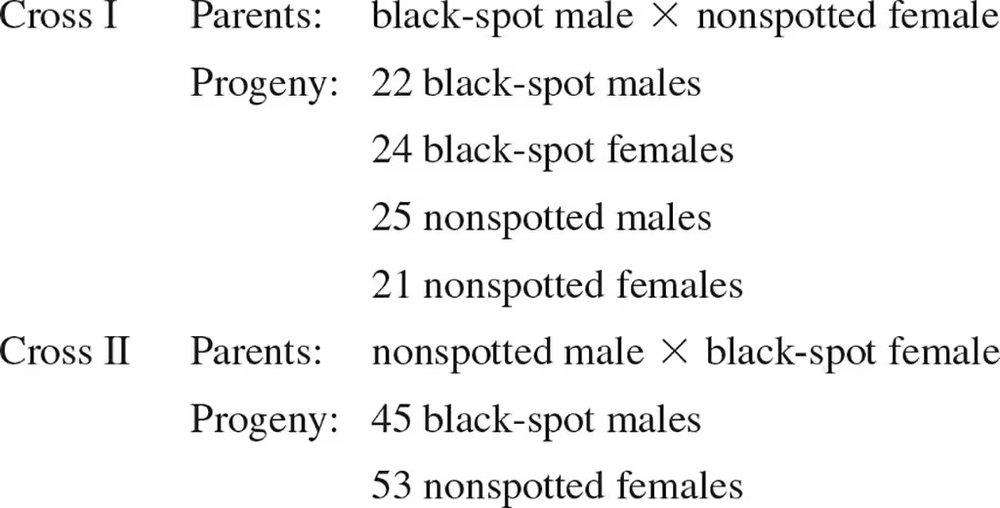
In a species of fish, a black spot on the dorsal fin is observed in males and females. A fish breeder carries out a pair of reciprocal crosses and observes the following results.
Genetic cross results showing progeny from black-spot and nonspotted fish, detailing sex and genotype outcomes.
Identify which sex is heterogametic. Give genotypes for the parents in each cross, and explain the progeny proportions in each cross.

Verified step by step guidance
1
Step 1: Understand the concept of heterogametic sex. In species with sexual reproduction, the heterogametic sex produces two different types of gametes with respect to the sex chromosomes (e.g., XY in males for humans, ZW in females for birds). The homogametic sex produces identical gametes (e.g., XX in females for humans, ZZ in males for birds). Analyze the data to determine which sex is heterogametic in this fish species.
Step 2: Analyze the results of Cross I. The black-spot male (presumed heterogametic) is crossed with a nonspotted female (presumed homogametic). The progeny includes both black-spot and nonspotted males and females in approximately equal proportions. This suggests that the black-spot trait is not sex-linked but rather autosomal, and the heterogametic sex determines the sex of the offspring.
Step 3: Analyze the results of Cross II. The nonspotted male (presumed heterogametic) is crossed with a black-spot female (presumed homogametic). The progeny includes only black-spot males and nonspotted females. This indicates that the sex of the offspring is determined by the male's gametes, consistent with the male being the heterogametic sex (XY system).
Step 4: Assign genotypes to the parents. For Cross I, the black-spot male could be heterozygous (Bb) for the black-spot trait, and the nonspotted female could be homozygous recessive (bb). For Cross II, the nonspotted male could be homozygous recessive (bb), and the black-spot female could be heterozygous (Bb). The black-spot trait appears to follow Mendelian autosomal inheritance.
Step 5: Explain the progeny proportions. In Cross I, the heterozygous black-spot male (Bb) and homozygous recessive nonspotted female (bb) produce a 1:1 ratio of black-spot (Bb) to nonspotted (bb) offspring, with equal numbers of males and females. In Cross II, the homozygous recessive nonspotted male (bb) and heterozygous black-spot female (Bb) produce a 1:1 ratio of black-spot males (Bb) to nonspotted females (bb), consistent with the male being the heterogametic sex.

Verified video answer for a similar problem:

This video solution was recommended by our tutors as helpful for the problem above.
Video duration:
1m
Was this helpful?

Key Concepts

Here are the essential concepts you must grasp in order to answer the question correctly.

Sex Determination and Heterogamety

In many species, sex is determined by specific chromosomes, with males and females having different combinations. Heterogametic sex refers to the sex that has two different sex chromosomes (e.g., XY in many animals), while the homogametic sex has two of the same (e.g., XX). Understanding which sex is heterogametic is crucial for predicting inheritance patterns and progeny ratios in genetic crosses.
Recommended video:
Guided course
04:24
Sex Determination

Genotype and Phenotype

Genotype refers to the genetic constitution of an organism, while phenotype is the observable physical or biochemical characteristics resulting from the genotype and environmental influences. In the context of the fish crosses, identifying the genotypes of the parents helps explain the phenotypic ratios of the progeny, as certain traits may be dominant or recessive.
Recommended video:
Guided course
07:52
Gamete Genotypes

Reciprocal Crosses

Reciprocal crosses involve switching the sexes of the parents in genetic experiments to determine the influence of sex on inheritance. By analyzing the results of both crosses, one can assess whether a trait is sex-linked or autosomal, and how it segregates in the offspring. This method is essential for understanding the inheritance patterns observed in the progeny of the fish in the question.
Recommended video:
Guided course
26:08
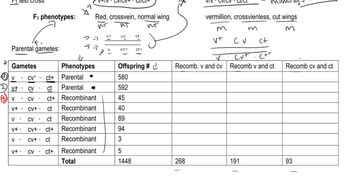
Trihybrid Cross
Related Practice
Textbook Question

The following figure illustrates reciprocal crosses involving chickens with sex-linked dominant barred mutation. For Cross A and for Cross B, cross the F₁ roosters and hens and predict the feather patterns of roosters and hens in the F2.

527
views
Textbook Question

In fruit flies, yellow body (y) is recessive to gray body , and the trait of body color is inherited on the X chromosome. Vestigial wing (v) is recessive to full-sized wing (v⁺), and the trait has autosomal inheritance. A cross of a male with yellow body and full wings to a female with gray body and full wings is made. Based on an analysis of the progeny of the cross shown below, determine the genotypes of parental and progeny flies.

[Table below appears at this point containing crosses and results]

1820
views
Textbook Question

In a species of fish, a black spot on the dorsal fin is observed in males and females. A fish breeder carries out a pair of reciprocal crosses and observes the following results.


Why does this evidence support the hypothesis that a black spot is sex linked?

471
views
Textbook Question

Lesch–Nyhan syndrome (OMIM 300322) is a rare X-linked recessive disorder that produces severe mental retardation, spastic cerebral palsy, and self-mutilation.


What is the probability that the first son of a woman whose brother has Lesch–Nyhan syndrome will be affected?

675
views
Textbook Question

Lesch–Nyhan syndrome (OMIM 300322) is a rare X-linked recessive disorder that produces severe mental retardation, spastic cerebral palsy, and self-mutilation.


If the first son of the woman described in (a) is affected, what is the probability that her second son is affected?

597
views
Textbook Question

Lesch–Nyhan syndrome (OMIM 300322) is a rare X-linked recessive disorder that produces severe mental retardation, spastic cerebral palsy, and self-mutilation.


What is the probability that the first son of a man whose brother has Lesch–Nyhan syndrome will be affected?

665
views