
Pearson+ LogoPearson+ Logo
Ch. 3 - Cell Division and Chromosome Heredity
Sanders - Genetic Analysis: An Integrated Approach 3rd Edition
Sanders3rd EditionGenetic Analysis: An Integrated ApproachISBN: 9780135564172Not the one you use?Change textbook
Chapter 3, Problem 17b

In cats, tortoiseshell coat color appears in females. A tortoiseshell coat has patches of dark brown fur and patches of orange fur that each in total cover about half the body but have a unique pattern in each female. Male cats can be either dark brown or orange, but a male cat with tortoiseshell coat is rarely produced. Two sample crosses between males and females from pure-breeding lines produced the tortoiseshell females shown.


Cross I     P: dark brown male × orange female
           F₁: orange males and tortoiseshell females
Cross II    P: orange male × dark brown female
           F₁: dark brown males and tortoiseshell females


Why are tortoiseshell cats female?

Verified step by step guidance
1
Understand that tortoiseshell coat color in cats is a sex-linked trait, meaning it is associated with the X chromosome. The gene responsible for coat color has two alleles: one for orange fur (O) and one for dark brown fur (B).
Recognize that females have two X chromosomes (XX), while males have one X and one Y chromosome (XY). This difference in sex chromosomes is key to understanding why tortoiseshell cats are female.
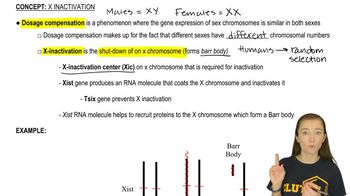
In females, the presence of two X chromosomes allows for one X chromosome to carry the orange allele (O) and the other X chromosome to carry the dark brown allele (B). Due to X-inactivation, one X chromosome in each cell is randomly silenced, leading to patches of orange and dark brown fur in tortoiseshell females.
In males, having only one X chromosome means they can only carry one allele for coat color (either O or B). Since males do not have a second X chromosome, they cannot exhibit the patchy coat pattern seen in tortoiseshell cats.
Rare male tortoiseshell cats can occur if they have an abnormal genotype, such as XXY (Klinefelter syndrome). In this case, the male has two X chromosomes, allowing for the same patchy coat pattern as seen in females.

Verified video answer for a similar problem:

This video solution was recommended by our tutors as helpful for the problem above.
Video duration:
1m
Was this helpful?

Key Concepts

Here are the essential concepts you must grasp in order to answer the question correctly.

X-Linked Inheritance

Tortoiseshell coat color in cats is a result of X-linked inheritance, where the genes responsible for the color are located on the X chromosome. Female cats have two X chromosomes, allowing them to express both color traits (orange and dark brown) simultaneously. In contrast, male cats have only one X chromosome, which limits their coat color to either orange or dark brown, making tortoiseshell males extremely rare.
Recommended video:
Guided course
09:30
X-Inactivation

Dosage Compensation

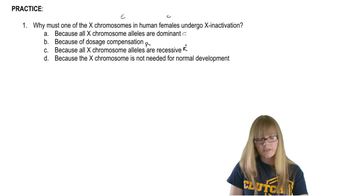
In female mammals, one of the two X chromosomes is randomly inactivated in a process called X-inactivation or dosage compensation. This results in a mosaic expression of the genes on the X chromosomes, leading to the characteristic patchwork of colors seen in tortoiseshell females. This phenomenon is crucial for understanding why tortoiseshell coloration is predominantly female.
Recommended video:
Guided course
00:52
Purpose of X Inactivation

Genetic Crosses and Phenotypes

The genetic crosses described in the question illustrate how different parental genotypes can produce specific offspring phenotypes. In the provided crosses, the combination of dark brown and orange fur colors in females results from the inheritance of different alleles from each parent. Understanding these crosses helps explain the inheritance patterns and the resulting phenotypes in tortoiseshell cats.
Recommended video:
Guided course
10:20
Monohybrid Cross
Related Practice
Textbook Question

A woman with severe discoloration of her tooth enamel has four children with a man who has normal tooth enamel. Two of the children, a boy (B) and a girl (G), have discolored enamel. Each has a mate with normal tooth enamel and produces several children. G has six children—four boys and two girls. Two of her boys and one of her girls have discolored enamel. B has seven children—four girls and three boys. All four of his daughters have discolored enamel, but all his boys have normal enamel. Explain the inheritance of this condition.

390
views
Textbook Question

In a large metropolitan hospital, cells from newborn babies are collected and examined microscopically over a 5-year period. Among approximately 7500 newborn males, six have one Barr body in the nuclei of their somatic cells. All other newborn males have no Barr bodies. Among 7500 female infants, four have two Barr bodies in each nucleus, two have no Barr bodies, and the rest have one. What is the cause of the unusual number of Barr bodies in a small number of male and female infants?

585
views
Textbook Question

In cats, tortoiseshell coat color appears in females. A tortoiseshell coat has patches of dark brown fur and patches of orange fur that each in total cover about half the body but have a unique pattern in each female. Male cats can be either dark brown or orange, but a male cat with tortoiseshell coat is rarely produced. Two sample crosses between males and females from pure-breeding lines produced the tortoiseshell females shown.


Cross I     P: dark brown male × orange female

           F₁: orange males and tortoiseshell females

Cross II    P: orange male × dark brown female

          F₁: dark brown males and tortoiseshell females


Explain the inheritance of dark brown, orange, and tortoiseshell coat colors in cats.

482
views
Textbook Question

In cats, tortoiseshell coat color appears in females. A tortoiseshell coat has patches of dark brown fur and patches of orange fur that each in total cover about half the body but have a unique pattern in each female. Male cats can be either dark brown or orange, but a male cat with tortoiseshell coat is rarely produced. Two sample crosses between males and females from pure-breeding lines produced the tortoiseshell females shown.


Cross I     P: dark brown male × orange female

           F₁: orange males and tortoiseshell females

Cross II    P: orange male × dark brown female

           F₁: dark brown males and tortoiseshell females


The genetics service of a large veterinary hospital gets referrals for three or four male tortoiseshell cats every year. These cats are invariably sterile and have underdeveloped testes. How are these tortoiseshell male cats produced? Why do you think they are sterile?

613
views
Textbook Question

The gene causing Coffin–Lowry syndrome (OMIM 303600) was recently identified and mapped on the human X chromosome. Coffin–Lowry syndrome is a rare disorder affecting brain morphology and development. It also produces skeletal and growth abnormalities, as well as abnormalities of motor control. Coffin–Lowry syndrome affects males who inherit a mutation of the X-linked gene. Most carrier females show no symptoms of the disease but a few carriers do. These carrier females are always less severely affected than males. Offer an explanation for this finding.

709
views
Textbook Question

Four eye-color mutants in Drosophila—apricot, brown, carnation, and purple—are inherited as recessive traits. Red is the dominant wild-type color of fruit-fly eyes. Eight crosses (A through H) are made between parents from pure-breeding lines.

Which of these eye-color mutants are X-linked recessive and which are autosomal recessive? Explain how you distinguish X-linked from autosomal heredity.

506
views