Textbook Question
For bacteria that are F⁺, Hfr, F', and F⁻ perform or answer the following.
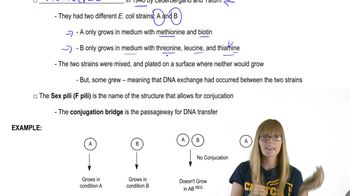
Which of these cells are donors? Which is the recipient?
488
views

 Sanders 3rd EditionCh. 6 - Genetic Analysis and Mapping in Bacteria and BacteriophagesProblem 1e
 Verified step by step guidance
 04:06
04:06
 08:52
08:52 03:03
03:03For bacteria that are F⁺, Hfr, F', and F⁻ perform or answer the following.
Which of these cells are donors? Which is the recipient?
For bacteria that are F⁺, Hfr, F', and F⁻, perform or answer the following.
Which of these donors can transfer a donor gene to exconjugants?
The flow diagram identifies relationships between bacterial strains in various F factor states. For each of the four arrows in the diagram, provide a description of the events involved in the transition.
For bacteria that are F⁺, Hfr, F', and F⁻, perform or answer the following.
Describe a "partial diploid" and how it originates.
Go online to the Online Mendelian Inheritance of Man (OMIM) website. Look up the following genetic conditions and answer the questions posed about them.
Go to the 'Molecular Genetics' section and describe the most common mutation of the CF gene.
For bacteria that are F⁺, Hfr, F', and F⁻ perform or answer the following.
Which of these donors can convert exconjugants to a donor state?