Pearson+ LogoPearson+ Logo
Ch.2 Chemistry and Measurements
Timberlake - Chemistry: An Introduction to General, Organic, and Biological Chemistry 14th Edition
Timberlake14thChemistry: An Introduction to General, Organic, and Biological ChemistryISBN: 9781292472249Not the one you use?Change textbook
Chapter 2, Problem 19a

Identify the numbers in each of the following statements as measured or exact:
a. Sandra has a patient with a mass of 67.5 kg.

Verified step by step guidance
1
Understand the difference between measured and exact numbers: Measured numbers are obtained using a measuring tool and have a degree of uncertainty, while exact numbers are counted or defined and have no uncertainty.
Analyze the given statement: 'Sandra has a patient with a mass of 67.5 kg.'
Recognize that the mass of 67.5 kg is obtained using a measuring tool, such as a scale, and therefore it is a measured number.
Consider the context: Mass is typically measured and reported with a specific number of significant figures, indicating the precision of the measurement.
Conclude that the number 67.5 kg in this statement is a measured number because it reflects a value obtained through measurement rather than a defined or counted quantity.

Verified video answer for a similar problem:

This video solution was recommended by our tutors as helpful for the problem above.
Video duration:
1m
Was this helpful?

Key Concepts

Here are the essential concepts you must grasp in order to answer the question correctly.

Measured Numbers

Measured numbers are values obtained through measurement and are subject to uncertainty. They include a degree of precision based on the measuring instrument used. For example, Sandra's patient's mass of 67.5 kg is a measured number because it reflects a specific measurement that can vary slightly depending on the scale's accuracy.
Recommended video:
Guided course
02:52
Measuring Radioactivity Concept 1

Exact Numbers

Exact numbers are values that are counted or defined and have no uncertainty associated with them. They are considered to have infinite precision. An example of an exact number is the number of patients in a study, such as 10 patients, which is a definitive count without any measurement error.
Recommended video:
Guided course
03:13
Calculate Oxidation Numbers

Significant Figures

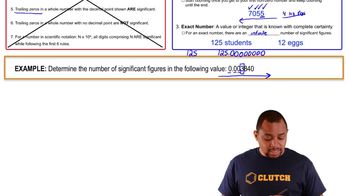
Significant figures are the digits in a number that contribute to its precision, including all non-zero digits, any zeros between them, and trailing zeros in the decimal portion. Understanding significant figures is crucial when interpreting measured numbers, as they indicate the reliability of the measurement. In the example of 67.5 kg, there are three significant figures, reflecting the precision of the measurement.
Recommended video:
Guided course
01:09
Significant Figures (Simplified) Example 2