Pearson+ LogoPearson+ Logo
Ch.6 Ionic and Molecular Compounds
Timberlake - Chemistry: An Introduction to General, Organic, and Biological Chemistry 14th Edition
Timberlake14thChemistry: An Introduction to General, Organic, and Biological ChemistryISBN: 9781292472249Not the one you use?Change textbook
Chapter 6, Problem 86b

Identify the major type of intermolecular forces between the particles of each of the following:
b. HCl

Verified step by step guidance
1
Step 1: Begin by identifying the type of molecule HCl is. HCl is a polar covalent molecule because the electronegativity difference between hydrogen (H) and chlorine (Cl) is significant, causing an uneven distribution of electron density.
Step 2: Recognize that polar molecules exhibit dipole-dipole interactions as their major type of intermolecular force. This occurs because the partial positive charge on the hydrogen atom is attracted to the partial negative charge on the chlorine atom of neighboring molecules.
Step 3: Consider whether hydrogen bonding is possible. Hydrogen bonding occurs when hydrogen is directly bonded to highly electronegative atoms like oxygen (O), nitrogen (N), or fluorine (F). Since HCl does not meet this criterion, hydrogen bonding is not present.
Step 4: Note that London dispersion forces (induced dipole-induced dipole interactions) are present in all molecules, but they are not the major intermolecular force in polar molecules like HCl. Dipole-dipole interactions dominate in this case.
Step 5: Conclude that the major type of intermolecular force in HCl is dipole-dipole interactions, which arise due to the polarity of the molecule.

Verified video answer for a similar problem:

This video solution was recommended by our tutors as helpful for the problem above.
Video duration:
1m
Was this helpful?

Key Concepts

Here are the essential concepts you must grasp in order to answer the question correctly.

Intermolecular Forces

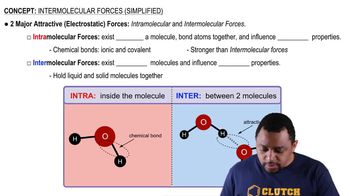
Intermolecular forces are the forces of attraction or repulsion between neighboring particles (atoms, molecules, or ions). They are crucial in determining the physical properties of substances, such as boiling and melting points. The main types of intermolecular forces include hydrogen bonding, dipole-dipole interactions, and London dispersion forces.
Recommended video:
Guided course
01:59
Intermolecular Forces (Simplified) Concept 1

Dipole-Dipole Interactions

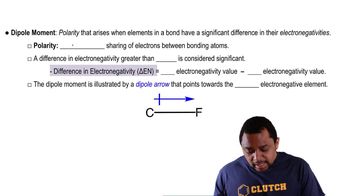
Dipole-dipole interactions occur between polar molecules, where positive and negative ends of the molecules attract each other. In the case of HCl, the molecule has a permanent dipole due to the difference in electronegativity between hydrogen and chlorine, leading to significant dipole-dipole interactions that influence its physical properties.
Recommended video:
Guided course
01:25
Dipole Moment (Simplified) Concept 2

Hydrogen Bonding

Hydrogen bonding is a specific type of strong dipole-dipole interaction that occurs when hydrogen is bonded to highly electronegative atoms like nitrogen, oxygen, or fluorine. While HCl does not form hydrogen bonds, understanding this concept is essential for comparing it with other molecules that do, as it highlights the strength and significance of intermolecular forces in molecular interactions.
Recommended video:
Guided course
1:22
Hydrogenation Reactions Concept 1