 Back
BackGOB Chemistry: DNA, Chromosomes, and Genes
 1:34
1:34
Terms in this set (28)
Chromatin is a compact tangle of DNA twisted around proteins called histones, found in the nucleus when a cell is not dividing.
Chromatin organizes into chromosomes, each containing a DNA molecule duplicated so each new cell gets a complete copy.
A gene is an individual segment of DNA that contains instructions to synthesize a single polypeptide.
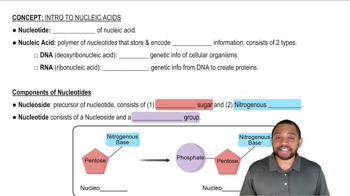
Nucleic acids are polymers of nucleotides, each made of a five-carbon sugar, a cyclic amine base, and a phosphate group.
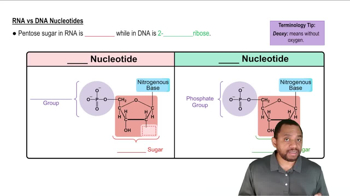
RNA contains D-ribose, while DNA contains 2-deoxyribose, missing an oxygen atom at the C2 position.
Thymine is only in DNA; Uracil is only in RNA; adenine, guanine, and cytosine are in both.
A nucleoside is a five-carbon sugar bonded to a cyclic amine base without a phosphate group.
Nucleotides are named by adding 5'-monophosphate to the nucleoside name, e.g., adenosine 5'-monophosphate (AMP).
Adenosine triphosphate (ATP) is a key biochemical energy source, releasing energy when converted to ADP.
Nucleotides connect via phosphodiester linkages between the 3' OH of one sugar and the 5' phosphate of the next.
A nucleotide chain has a free phosphate at the 5' end and a free OH at the 3' end; sequences are read 5' to 3'.
DNA is a right-handed double helix with sugar-phosphate backbones outside and complementary base pairs inside.
The two DNA strands run in opposite directions: one 5' to 3', the other 3' to 5'.
Adenine pairs with thymine via 2 hydrogen bonds; cytosine pairs with guanine via 3 hydrogen bonds.
DNA replication copies DNA before cell division, involving unwinding by helicase and synthesis by DNA polymerase.
Replication forks are branch points where DNA strands separate to allow replication to begin.
DNA polymerase adds nucleotides to the 3' OH of the growing strand, reading the template 3' to 5' and synthesizing 5' to 3'.
The leading strand is synthesized continuously 5' to 3'; the lagging strand is synthesized in Okazaki fragments.
Each new DNA double helix contains one original template strand and one newly synthesized strand.
mRNA carries genetic info from DNA; tRNA delivers amino acids; rRNA forms ribosome structure for protein synthesis.
Transcription is the synthesis of RNA from a DNA template strand by RNA polymerase.
mRNA is complementary to the DNA template strand and matches the informational strand except U replaces T.
Exons code for proteins; introns are non-coding sequences removed during mRNA processing.
A codon is a sequence of three nucleotides in mRNA that codes for an amino acid or signals translation stop.
Protein synthesis involves initiation, elongation, and termination at the ribosome.
mRNA, the first tRNA with methionine, and the small ribosomal subunit assemble; the large subunit then joins.
New tRNAs bring amino acids, peptide bonds form, and the ribosome shifts to add amino acids to the chain.
A stop codon signals release factors to cleave the polypeptide and disassemble the translation complex.