What happens to triacylglycerols (TAGs) in the mouth and stomach during digestion?
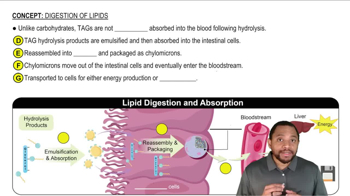
TAGs pass through the mouth unchanged and enter the stomach, where heat and churning break lipids into smaller droplets.
What triggers the release of pancreatic lipases in the small intestine?
The arrival of partially digested food in the duodenum triggers pancreatic lipase release for lipid hydrolysis.
What role does bile play in lipid digestion?
Bile acids and phospholipids emulsify lipid droplets, increasing surface area for pancreatic lipase action.
What are the main products of pancreatic lipase hydrolysis of triacylglycerols?
Mainly mono- and diacylglycerols, fatty acids, and a small amount of glycerol.
How are smaller fatty acids and glycerol absorbed in the intestine?
They are water-soluble and absorbed directly through villi into the bloodstream via capillaries.
How are larger acylglycerols and fatty acids absorbed?
They are packaged into chylomicrons and absorbed into the lymphatic system through lacteals.
What are lipoproteins and their general structure?
Lipoproteins have a core of neutral lipids (TAGs, cholesteryl esters) surrounded by a phospholipid layer with embedded proteins and cholesterol.
How does lipoprotein density relate to lipid and protein content?
Density depends on lipid-to-protein ratio; more lipids mean lower density.
What is the function of chylomicrons?
They transport dietary lipids from the intestine to peripheral tissues and lymph.
What do very-low-density lipoproteins (VLDLs) transport?
VLDLs carry triacylglycerols synthesized in the liver to peripheral tissues.
What is the role of low-density lipoproteins (LDLs)?
LDLs transport cholesterol from the liver to peripheral tissues for membranes or steroid synthesis.
What is the function of high-density lipoproteins (HDLs)?
HDLs transport cholesterol from dead cells back to the liver for bile acid synthesis or excretion.
What happens to triacylglycerols after hydrolysis in metabolism?
Fatty acids are resynthesized for storage or converted to acetyl-SCoA; glycerol enters glycolysis or gluconeogenesis.
How is triacylglycerol synthesis activated in adipose tissue after a meal?
High blood glucose raises insulin, activating TAG synthesis from glycerol 3-phosphate and fatty acyl-CoA.
What enzyme controls triacylglycerol hydrolysis during fasting?
Triacylglycerol lipase is activated by low insulin and high glucagon to mobilize stored TAGs.
What are the three main steps for fatty acid oxidation in cells?
Activation to fatty acyl-SCoA, transport into mitochondria via carnitine, and β-oxidation to acetyl-SCoA.
What occurs during the first step of β-oxidation?
FAD removes hydrogens from α and β carbons, forming a carbon-carbon double bond.
What is the role of NAD+ in β-oxidation?
NAD+ oxidizes the β-hydroxyl group to a carbonyl group in the third step.
What is produced at the end of each β-oxidation cycle?
An acetyl-SCoA molecule and a fatty acyl-SCoA shortened by two carbons.
How much ATP is approximately produced per β-oxidation cycle?
Each cycle produces 1 NADH and 1 FADH2, yielding about 4 ATP equivalents.
What are ketone bodies and when are they produced?
Ketone bodies (3-hydroxybutyrate, acetoacetate, acetone) are produced in the liver when acetyl-SCoA exceeds citric acid cycle capacity.
What is ketoacidosis and its effects?
A dangerous drop in blood pH due to excess ketone bodies, causing dehydration, labored breathing, and potentially coma.
What is lipogenesis?
The biosynthesis of fatty acids from acetyl-SCoA, linking carbohydrate and lipid metabolism.
How does fatty acid synthesis differ from β-oxidation?
Fatty acid synthesis occurs in the cytosol, uses NADPH, and adds two carbons at a time; β-oxidation occurs in mitochondria, uses FAD and NAD+, and removes two carbons.
What is the role of malonyl-SCoA in fatty acid synthesis?
Malonyl-SCoA donates two-carbon units to elongate the fatty acid chain during synthesis.
What are the four main reactions in the fatty acid elongation cycle?
Condensation, reduction, dehydration, and a second reduction to add two carbons.
What is the final product of fatty acid synthesis after seven elongation cycles?
 Back
Back
 1:41
1:41