Pearson+ LogoPearson+ Logo
Ch.1 Chemistry in Our Lives
Timberlake - Chemistry: An Introduction to General, Organic, and Biological Chemistry 14th Edition
Timberlake14thChemistry: An Introduction to General, Organic, and Biological ChemistryISBN: 9781292472249Not the one you use?Change textbook
Chapter 1, Problem 30b

Write each of the following in scientific notation:
b. 1500

Verified step by step guidance
1
Identify the number to be converted into scientific notation: 1500.
Determine the position of the decimal point in the number. For 1500, the decimal point is implicitly at the end: 1500.0.
Move the decimal point to create a number between 1 and 10. In this case, move the decimal point three places to the left, resulting in 1.5.
Count the number of places the decimal point was moved. Since it was moved three places, the exponent for the power of 10 will be 3.
Express the number in scientific notation using the format \( a \times 10^n \), where \( a \) is the number between 1 and 10 and \( n \) is the exponent. For this problem, the scientific notation is \( 1.5 \times 10^3 \).

Verified video answer for a similar problem:

This video solution was recommended by our tutors as helpful for the problem above.
Video duration:
1m
Was this helpful?

Key Concepts

Here are the essential concepts you must grasp in order to answer the question correctly.

Scientific Notation

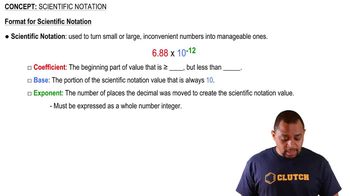
Scientific notation is a method of expressing numbers that are too large or too small in a compact form. It is written as the product of a number between 1 and 10 and a power of ten. For example, the number 1500 can be expressed as 1.5 x 10^3, where 1.5 is the coefficient and 3 is the exponent indicating the number of places the decimal point has moved.
Recommended video:
Guided course
01:41
Scientific Notation

Significant Figures

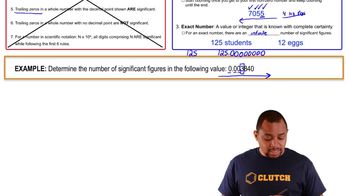
Significant figures are the digits in a number that contribute to its precision. In scientific notation, the significant figures are represented in the coefficient. For instance, in the number 1.5 x 10^3, the '1.5' has two significant figures, which indicates the precision of the measurement being represented.
Recommended video:
Guided course
01:09
Significant Figures (Simplified) Example 2

Exponent Rules

Exponent rules govern how to manipulate numbers expressed in exponential form. When converting numbers to scientific notation, understanding how to apply these rules is essential, especially when multiplying or dividing numbers with the same base. For example, when multiplying two numbers in scientific notation, you add their exponents, which is crucial for accurate calculations.
Recommended video:
Guided course
00:28
Solubility Rules