Pearson+ LogoPearson+ Logo
Ch.18 Metabolic Pathways and ATP Production
Timberlake - Chemistry: An Introduction to General, Organic, and Biological Chemistry 14th Edition
Timberlake14thChemistry: An Introduction to General, Organic, and Biological ChemistryISBN: 9781292472249Not the one you use?Change textbook
Chapter 18, Problem 6

A person swims for 0.50 h and uses 250 kcal. How many moles of ATP are used to provide this amount of energy?

Verified step by step guidance
1
Step 1: Understand the problem. The goal is to determine how many moles of ATP are used to provide 250 kcal of energy during swimming. ATP (adenosine triphosphate) is the molecule that provides energy for cellular processes, and its energy release per mole is approximately 7.3 kcal/mol.
Step 2: Write the relationship between energy and moles of ATP. The energy released per mole of ATP is given as 7.3 kcal/mol. Use the formula: n=EΔH, where n is the number of moles, E is the energy used (250 kcal), and ΔH is the energy released per mole of ATP (7.3 kcal/mol).
Step 3: Substitute the given values into the formula. Replace E with 250 kcal and ΔH with 7.3 kcal/mol in the formula: n=2507.3.
Step 4: Perform the division to calculate the number of moles of ATP. Divide 250 kcal by 7.3 kcal/mol to find the value of n. This step will give the number of moles of ATP used.
Step 5: Interpret the result. The calculated value represents the number of moles of ATP required to provide 250 kcal of energy during swimming. Ensure the units are consistent and the result makes sense in the context of the problem.

Key Concepts

Here are the essential concepts you must grasp in order to answer the question correctly.

Energy Conversion in Metabolism

In biological systems, energy from food is converted into usable forms, primarily ATP (adenosine triphosphate). During physical activities like swimming, the body metabolizes carbohydrates and fats to produce ATP, which fuels muscle contractions. Understanding this conversion is essential for calculating the energy expenditure in terms of ATP production.
Recommended video:
Guided course
03:45
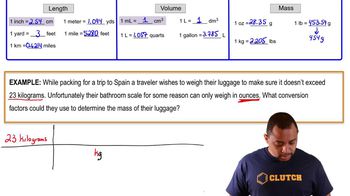
Conversion Factors (Simplified) Example 2

Caloric Value of ATP

One mole of ATP releases approximately 7.3 kcal of energy when hydrolyzed. This value is crucial for converting the total energy expenditure (in kcal) into moles of ATP. By knowing how much energy is released per mole of ATP, we can determine how many moles are required to meet the energy demands of the activity performed.
Recommended video:
Guided course
2:20
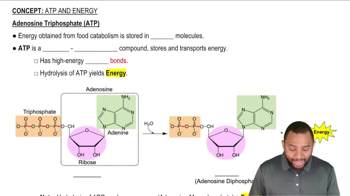
Adenosine Triphosphate (ATP) Concept 2

Stoichiometry in Biochemical Reactions

Stoichiometry involves the calculation of reactants and products in chemical reactions. In the context of ATP production, it allows us to relate the amount of energy used (in kcal) to the number of moles of ATP produced or consumed. This concept is fundamental for quantifying metabolic processes and understanding energy balance during physical activities.
Recommended video:
Guided course
01:16
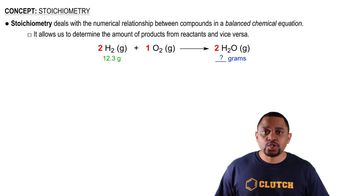
Stoichiometry